In the Gaze of God, Introduction
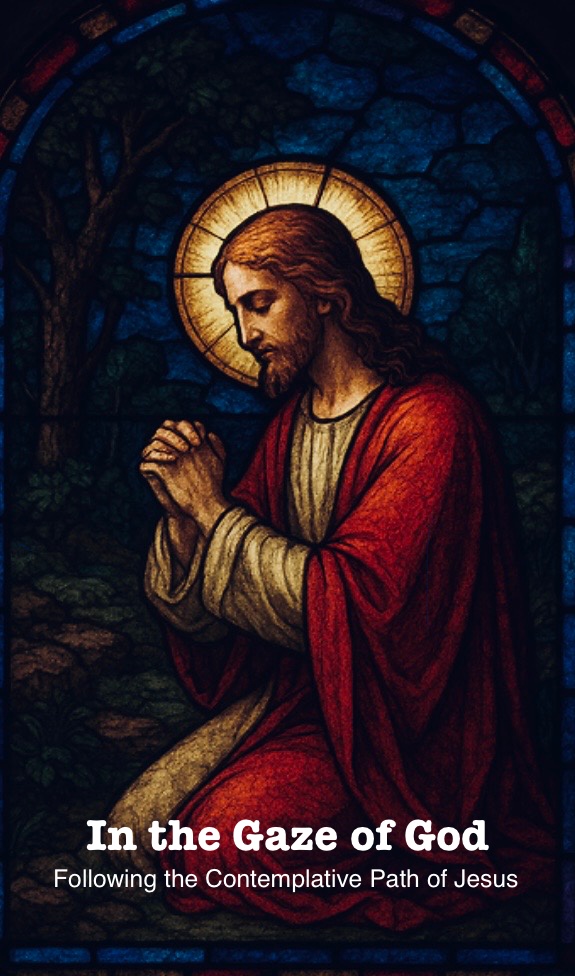
The Contemplative Path of Jesus
In Psalm 25, David prays a profound yet simple prayer:
“Show me your ways, O Lord, and teach me your paths.”
As we become more and more aware of Jesus, we are drawn to His way. A simple reading of the Gospels demonstrates His love, His compassion, His heart, His strength, and His wisdom. Jesus had a non-anxious, non-judgmental, non-controlling, non-reactive presence. We long to be like that – to live like that!
In all of these “non-” descriptors, we see the “what” of Jesus’ life, but we may not be aware of the “how,” i.e., His path. His path or His way is the reason He lived as He did. Isaiah 55 tells us that God’s ways are not our ways. But what is God’s way? Specifically, what is the way of Jesus?
Jesus lived contemplatively.
Rather than reacting to the world around Him, Jesus responded to the Father, being led by the Holy Spirit. In John 5:19, Jesus says about Himself: “The Son of Man can do nothing of His own accord but only what He sees the Father doing.” A few verses later (5:30) He says: “I can do nothing on my own. As I hear, I judge (or discern), and my judgment (discernment) is just, because I seek not my own will but the will of him who sent me.” What Jesus did and what He discerned were rooted in looking at and listening to His Father.
At His baptism in Matthew 3, before He had engaged in any ministry or preached a sermon, the Father looked at Him and said, “This is my Son, the beloved, in whom I take delight,” It was from this place of being gazed upon by the Father that He proceeded, doing and discerning. He lived in the gaze of God. In the next chapter of Matthew (4), His desire to live in the gaze of God was tested in the wilderness. Next, He offered the Sermon on the Mount (Matthew 5-7) as an invitation to others to live in the gaze of God.
We live in a world immersed in reactivity and control. Rather than responding to life from a place of patient reflection and receiving from the gaze of God, we have learned to react from a place of living under a different gaze.
1 John 2:15-17 describes it as the ways (path) of the world in which the message received is that we are not enough, we haven’t done enough, and we don’t have enough. When we live non-contemplatively, we find false security and we are caught in a cycle of inordinate attachments and unceasing striving.
Jesus invites us to something different.
Come, Follow Me …
In Matthew 11:28–30, Jesus’ invitation is familiar:
Come to me, all who labor and are heavy laden, and I will give you rest. Take my yoke upon you, and learn from me, for I am gentle and lowly in heart, and you will find rest for your souls. For my yoke is easy, and my burden is light.
Yes! Of course, this matches that desire to be like Him, to live like Him. What we often miss is the context. Notice the verse right before this passage:
All things have been handed over to me by my Father, and no one knows the Son except the Father, and no one knows the Father except the Son and anyone to whom the Son chooses to reveal him. (Matthew 11:27)
It is this revelation of the Father that Jesus offers at the end of Matthew 11. His yoke or His way is rooted in the revelation of the Father which is the experience of His gaze. Jesus invites us into encounter with the living God who called Him Son and beloved and delightful. Instead of the voices of the world, we hear the voice of God which says we are enough (“you are my son/daughter”), we’ve done enough (“you have my love, period”), and we have enough (“you have all that you need”).
What does it look like to live in the gaze of God? This will be our exploration through these forty days of reflections. Interestingly, in the early church, a hymn emerged that described Christ’s contemplative way. Paul quotes from this hymn in Philippians 2:
Have this mind among yourselves, which is yours in Christ Jesus, who, though he was in the form of God, did not count equality with God a thing to be grasped, but emptied himself, by taking the form of a servant, being born in the likeness of men. And being found in human form, he humbled himself by becoming obedient to the point of death, even death on a cross (vv. 5-8)
What does this tell us about the contemplative path of Jesus?
First, Jesus did not grasp or try to use His equality with God to gain something for Himself. He surrenderedto His relationship with Father and Spirit. He released clinging and fighting and striving in order to rest in who He was.
Second, we find the words “made Himself nothing” which might be more accurately translated from the Greek as “emptied Himself.” From a place of rest, He sat empty of any need to define, defend, or declare self. He received and rested in the reality that He was actively being loved by God the Father.
Third, Jesus humbled Himself. Rather than relying upon His own perspective, He became a servant. A servant is one who is aware of and responsive to a master. Being surrendered and sitting in love, He could see what was invited for His life.
The contemplative rhythm that shaped and led Jesus is this: surrender, sit, and see. This is the rhythm we will observe at His baptism, in the 40 days in the wilderness, and through the Sermon on the Mount.
We too are invited to live in the gaze of God. If we are in Christ, the words spoken over Jesus at His baptism are also spoken over us. We have the same invitation to surrender to Him, sit in His gaze, and seewith His eyes.
The letter to the Hebrews (4:15) tells us that “we do not have a high priest who is unable to sympathize with our weaknesses, but one who in every respect has been tempted as we are, yet without sin.” We will be tempted away from this contemplative posture, and Jesus understands as He experienced the same. Of course, this happened in the wilderness of Matthew 4 and in Matthew 22 as He asked that the cup of suffering be taken away. He responded with that first part of the contemplative path: surrender (“not My will but Thy will be done”).
Sermon on the Mount
After emerging from the wilderness, Jesus taught the longest recorded sermon of His ministry. In ancient writings and teachings, the structure often followed an X (or, chiastic pattern) in which the teaching begins and ends in the same place with the main point in the middle.
Jesus began with talking about the kingdom of God: “Blessed are the poor in the spirit, for theirs is the kingdom of heaven” (Matt 5:3). He ended with challenging: “Not everyone who says to me, ‘Lord, Lord,’ will enter the kingdom of heaven, but the one who does the will of my Father who is in heaven” (Matt 7:21). Because “heaven” was the Jewish way of saying “God,” kingdom of God and kingdom of heaven are interchangeable. The kingdom of God is the presence and action of God in the world. Getting in touch with the “kingdom” is to live with an awareness of His presence. The middle of the sermon (or, the main point) is Jesus’ teaching on prayer: both the invitation to go into one’s inner room and the Lord’s Prayer.
How do we live with an awareness and responsiveness to the presence of God? How do we live in the gaze of God? By learning to pray as Jesus did.
It is fascinating to note that each part of the Lord’s Prayer addresses the contemplative rhythm Jesus modeled:
- Surrender – “may Your kingdom come; may Your will be done” – releasing the self
- Sit – “forgive us our trespasses as we forgive others” – resting in His love
- See – “give us our daily bread” – receiving His provision
The rest of the Sermon on the Mount challenges us to look at the ways we are drawn away from this contemplative rhythm. As we reflect on Jesus’ temptations in the wilderness, Jesus walks us though how to come back again and again to surrender, sit, and see. As we do, we let go of our reactions of anger, shame, and anxiety, and instead respond from the presence of God in the world around us.
An Overview of the Journey
These forty days track along with the Lenten Season, starting on Ash Wednesday. The days of Lent are counted Monday through Saturday with Sunday being a feast day/celebration. If one fasts during Lent, Sunday is a day to eat and give thanks – a day to celebrate the resurrection in the midst of the journey. The forty days of Lent reflect on the forty days of Jesus in the wilderness. It was there that He fasted and engage in spiritual battle. This time of wilderness is the heart of these reflections on the gaze of God.
Below is an outline of each week of “In the Gaze of God.” Each week has six days of reflections (except the first which starts on Ash Wednesday) and the seventh day of each week is an invitation to a contemplative practice.
ONE: Contemplation: a Long, Loving Look at God
TWO: Connection: in the Gaze of God, Matthew 3
THREE: Wilderness: from Temptation to Deliverance Matthew 4
FOUR: Surrender: from Anger to Stillness, Matthew 5
FIVE: Sit: from Shame to Solitude, Matthew 6
SIX: See: From Anxiety to Silence, Matthew 6
SEVEN: Peace: from Distraction to Presence, Matthew 7
A Prayer as We Begin this Journey
“Show me your ways, O Lord,
and teach me your paths.”
Psalm 25:3
As we lead up to this forty-day reflection on what Jesus experienced and learned in the wilderness, let’s pray this prayer together.

Posted on February 6, 2026, in blog, In the Gaze of God. Bookmark the permalink. 2 Comments.
 desert direction
Ted, have you published this (yet)? I would love to meditate on it in paper form! Thank you. Sylvia
Not yet. Maybe later this year.