Day 2 | Jesus and the Quiet Place
Week 1 | Contemplation: A Long, Loving Look at God
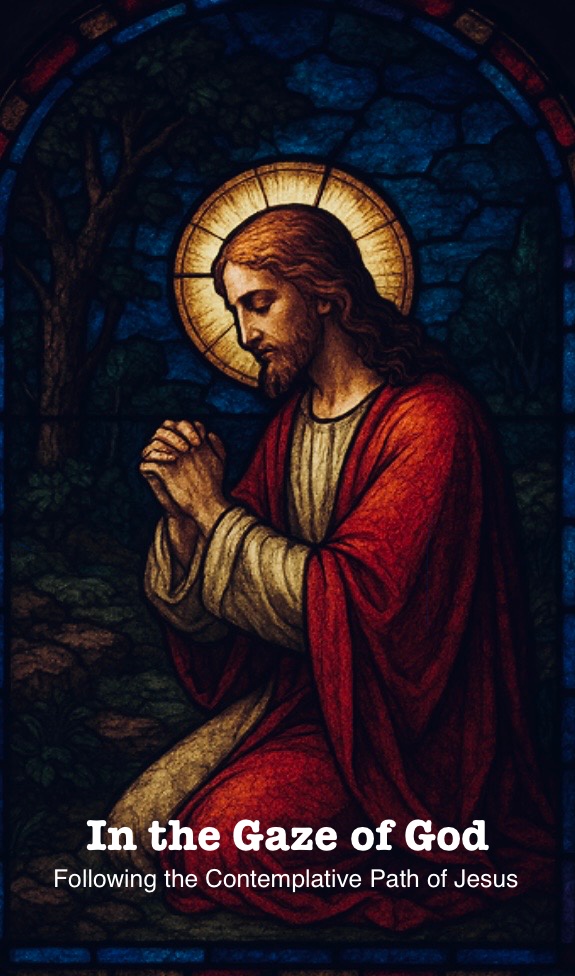
Day 2: Jesus and the Quiet Place
One of the most striking features of Jesus’ life was His pattern of retreat. He retreated to the desert, a mountain, or a garden repeatedly (cf., Matthew 4:1; 14:13, 23; 17:11; Mark 1:12-13, 35; 6:31, 46; Luke 4:1-2, 42; 5:16; 6:12; 9:18; 22:39-41; John 6:15; 18:1-2). Jesus nurtured His life with God the Father (living in His gaze) by going to a quiet place.
Clearly, Jesus lived an active life of ministry. He gave Himself away. This was balanced and nurtured by a regular pattern of withdrawal. He stepped away from the crowds and the noise, to go to places where He likely would not be found. As we walk through life, we are wise to follow Jesus in this way. If we are going to confront the hard things of life – both external to us and the wounds we hold inside – we have to get “off the scene.”
Henri Nouwen describes the quiet place where you cannot be found by anyone but God: “solitude is the place of the great struggle and the great encounter – the struggle against the compulsions of the false self, and the encounter with the loving God who offers himself as the substance of the new self.”
The desert, in Jesus’ time, was not an idyllic retreat location, but a place of desolation, deprivation, and danger. At the same time, historically, it was a place where the people of God encountered God in profound ways. And of course, the mountain was a place of encounter as well.
In Mark 1, Jesus begins His public ministry – calling His disciples, delivering a man with an unclean spirit, and healing many others who were sick. Mark comments that “the whole city was gathered” (v. 33). The text goes on to say that Jesus would not let the demons He cast out speak, “because they knew Him” (v. 34). Many other times, Jesus asked people not to share who He was. He had a sense of the Father’s timing and in what He had come to do. The temptation was real for Him to be swayed by people clamoring for more than He was being led to offer. This tension point had to be taken to prayer. So, the narrative goes on:
And rising very early in the morning, while it was still dark, He departed and went out to a desolate place, and there He prayed. And Simon and those who were with him searched for Him, and they found Him and they said to him, ‘Everyone is looking for you.’ And He said to them, ‘Let us go on to the next towns, that I may preach there also, for that is why I came out” (Mark 1:35-38).
Several features of this passage are worth noting. First, it was early and dark. Like an athlete who gets up early to train, this demonstrates Jesus’ commitment to the quiet place with His Father. This time of day was also important because people would still be asleep and not able to pull Jesus away. Second, His disciples appeared to be a bit annoyed, exaggerating that “everyone is looking for you.” As we follow Jesus and His contemplative path, there will be people in our lives who want to distract us or even derail our pursuit of the quiet place. Finally, Jesus responded to the requests to come back to town with, “Let’s go on to the next towns, that I may preach there also, for that is what I came out for.” The reason for coming out (or, departing) from the city was so that He could preach. Jesus knew His mission and if He held one healing clinic after another, that would leave Him with no space to preach the gospel of the kingdom. We too need the quiet space to recenter and return to who we are and what we are called to do.
Without the quiet place, we will find ourselves swayed by the winds and storms of life and relationships. As we come out of the quiet place, we are renewed and strengthened. Abba Moses, a 4th century desert father, said, “Go, sit in your cell and your cell will teach you everything.” In a very clear, concrete way, he is saying: Formation happens in the quiet place with God.
As we begin this exploration of the contemplative way of Jesus, we begin with the concrete, practical encouragement to create a time and place to practice contemplation. It is here that we practice metanoia – returning again and again to presence. Without that, our desire to follow Jesus becomes a wish with little hope for fulfillment.
Take a few moments and decide the “where” and the “when” for your contemplative practice. Contemplation does not grow in crowded soil. You may need to clear away some clutter.
Prayer: O God, you will keep in perfect peace those whose minds are fixed on you. For in returning and rest we shall be saved. In quietness and trust shall be our strength. Amen.

Posted on February 19, 2026, in blog, In the Gaze of God. Bookmark the permalink. Leave a comment.
 desert direction
Leave a comment
Comments 0