Day 3 | The Prayer Closet
Week 1 | Contemplation: A Long, Loving Look at God
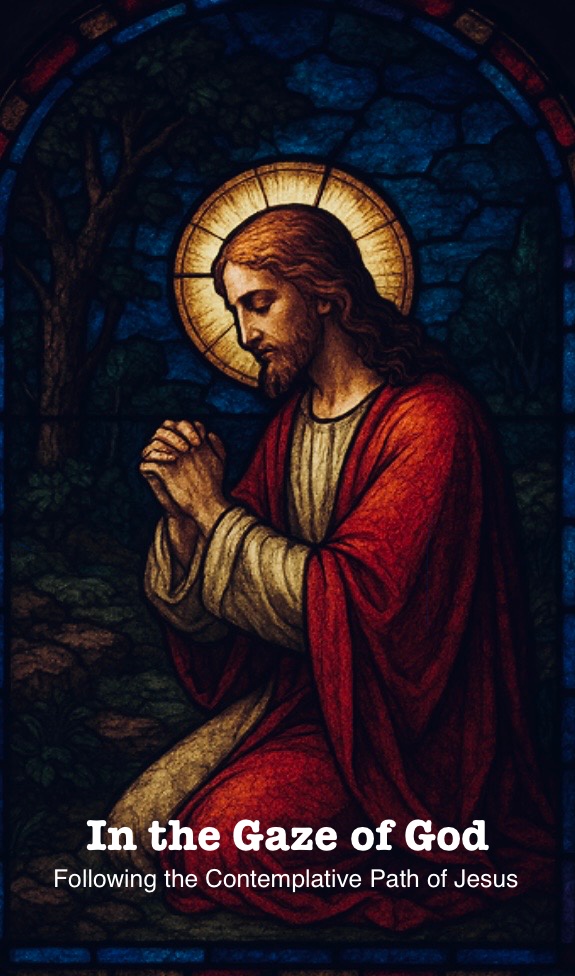
When we read that Jesus “went up on the mountain by himself to pray” (Matt 14:23), we may wonder what He was praying about “all night” (Luke 6:12). Because Jesus would have given Himself already to the regular prayers the Jewish people offered each day, the Gospel writers note these withdrawals for prayer because they were not the norm. In fact, His disciples asked “teach us to pray” (Luke 11:1) because what he was doing was so different.
These prayers of Jesus were not about a particular form and content, but quiet prayers of the heart, giving loving attention to God. Jesus explains this in the Sermon on the Mount in Matthew 6:6: “But when you pray, go into your (inner) room and shut the door and pray to your Father who is in secret. And your Father who sees in secret will reward you.”
In talking about an inner room (Greek, tameion: secret chamber, a closet where valuables might be kept), Jesus speaks metaphorically about one’s heart. Through His actions, He demonstrated getting away physically, and now He speaks of retreating to the interior of our hearts. This was the understanding of the early church. Origen (early 3rd century) said: “The ‘inner room’ is the heart of the believer, and the shutting of the door is the closing off of the senses, so the soul may converse with God alone.”
The suggestion to “close the door” forms the foundation for contemplation. It invites stillness, solitude, and silence in the interior of one’s life. Stillness reflects the release of activity and striving. It can be helpful to allow one’s body to relax through breathing, good posture, and a comfortable seat. Solitude suggests letting go of anyone who might be physically or emotionally near by, in order to be with God alone. Finally, silence is about letting go of words and thoughts, not fighting these but simply not grasping for them or entertaining them. As we release or let go, we simply notice and return to God who enough.
Augustine commented: “Your desire is your prayer; if your desire is continual, your prayer is continual.” In Matthew 6, Jesus contrasts receiving reward from those around us with receiving reward from God. There is a reward to simply be in His presence. This reward may be readily apparent, or we may wait to fully understand. Jesus invites us to let go of any perceived reward we may gain from practicing our faith in front of others to something better. Jesus taps into the reality that we “are a desire for God” (Alan Jones).
In this invitation to retreat to the inner room of our heart, it is desire that leads us there and it is desire that is nurtured. Psalm 63:1 expresses this desire: “O God, you are my God, earnestly I seek you; my soul thirsts for you; my flesh faints for you, as in a dry and weary land where there is no water.” When we desire something, we wait for it. Perhaps this gives some context for Psalm 62:1: “For God alone my soul waits in silence …” The prayer of the heart is a waiting prayer simply for the sake of God Himself. He is the reward.
And so, why the heart? Why not stay with our thoughts of God and meditate there? It is important to note that this is not mindless prayer, even though it is in the heart. The 19th century Russian mystic Theophan the Recluse helps clarify as he wrote: “To pray is to descend with the mind into the heart, and there to stand before the face of the Lord, ever-present, all-seeing, within you.” He goes further in saying: “At present, your thoughts of God are in your head. And God himself, is as it were, outside you, and so your prayer and other spiritual exercises remain exterior. Whilst you are still in your head, thoughts will not easily be subdued but will always be whirling about, like snow in winter or clouds of mosquitos in the summer.”
Paul describes this dynamic in his prayer in Ephesians 3: “… that He may grant you to be strengthened with power thought his Spirit in your inner being, so that Christ may dwell in your hearts through faith – that you being rooted and grounded in love, may have strength to comprehend with all the saints what is the breadth and length and height and depth, and to know the love of Christ that surpasses knowledge.”
Clearly, this is a prayer that something would happen in the heart (one’s inner being). What happens in the heart is a “knowing” that surpasses knowledge. In other words, it is an experiential knowing. This happens through stillness, solitude, and silence.
Take a few minutes today – at least five – and simply sit with God in a quiet prayer of the heart. There is nothing to discuss, nothing to do, and nothing to decide. Just be in His presence. If you notice you are distracted, gently return to your desire. Make this a daily commitment until the end of this study.
Prayer: “O God, you are my God, earnestly I seek you; my soul thirsts for you; my flesh faints for you, as in a dry and weary land where there is no water.” Amen. (Ps 63:1)

Posted on February 20, 2026, in blog, In the Gaze of God. Bookmark the permalink. Leave a comment.
 desert direction
Leave a comment
Comments 0