Day 4 | I Look at Him and He Looks at Me
Week 1 | Contemplation: A Long, Loving Look at God
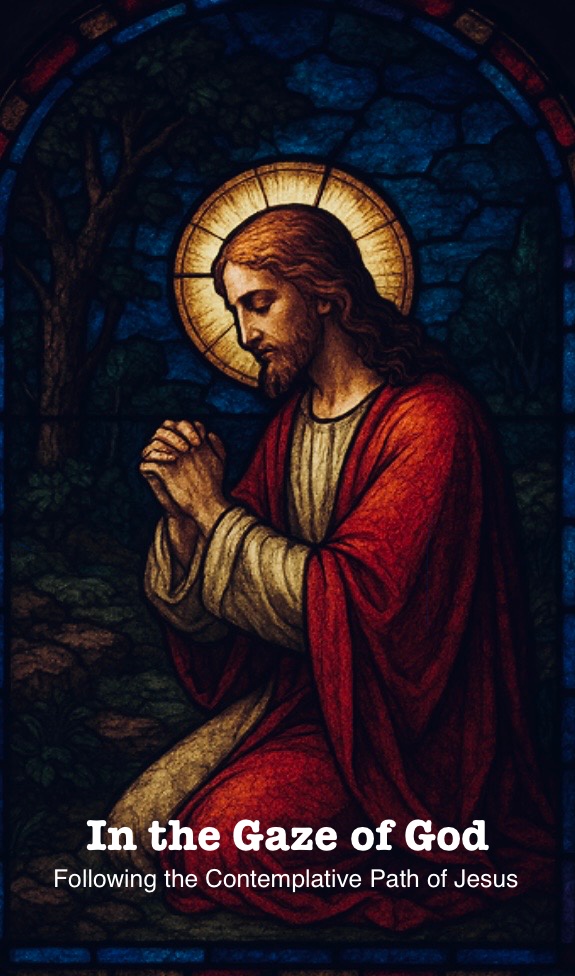
Theologian Walter J. Burghardt, S.J. described contemplation as “a long, loving look at the Real.” Consider that statement for a moment. Each part. Long – contemplation is not at “drive-thru” speed but slow and patient. Loving – contemplation is relational, not transactional. Look – contemplation is about intuitive awareness, not intellectual knowing. Finally, the Real – God is the reality in which we abide in contemplation.
As we turn (metanoia) to look at Him, we surrender to His gaze, we sit in His gaze, and then we see how He is with us and in the world around us.
St. John Vianney, a 17th century French priest, told the story of observing a peasant sitting silently for hours in the pews of a church. He asked him: “What are you doing all that time?” The man replied, “I look at Him, and He looks at me.”
In Jesus’ words in the Sermon on the Mount, He shares that the Father sees us as we engage Him in that quiet prayer of the heart. Of course, God sees us all the time but Jesus speaks of a “seeing” that is about awareness and beholding. It is relational rather than informational. As we come to contemplative prayer, we rest in the awareness that God is aware of us. We behold the reality that He is beholding us. It is a shared awareness that could be called intimacy. This is why Paul writes in 1 Corinthians 2 that we share “the mind of Christ.” His awareness is accessible to us.
We will explore the Father’s gaze further as we look at the baptism of Jesus, but the heart of it was a beholding in love. Jesus returned the Father’s gaze with His own. In John 5:19, we read: “The Son of Man can do nothing of his own accord, but only what He sees the Father doing.” This awareness of the Father’s activity only came by contemplation. Jesus lived in the gaze of God the Father, and acted from that gaze.
The 13th century mystic theologian Meister Eckhart described what happens in contemplation: “The eye through which I see God is the same eye through which God sees me; my eye and God’s eye are one eye, one seeing, one knowing, one love.” Indeed, it is a picture of shared awareness or intimacy. Contemplation is not achieved as much as it received. We receive and experience what is already there in Christ. This can cut against much of our “religious” instinct to work for spiritual growth and development. The invitation is to show up to the One who has already shown up to us.
The noisiness of our world conspires against this contemplative way. Certainly, we are wise to pay attention to the presence of physical noise, our own internal noise due to wounds and compulsions, and even digital noise. However, the most difficult noise we can experience is the incessant drive to make something happen – to conquer – to achieve. This voice is in the air around us, seemingly accusing us if we aren’t “winning” at life. The soul is not conquered and tamed through effort and discipline. In fact, this is not even the goal. The goal is loving presence so that what is present might emerge.
Parker Palmer beautifully described the soul and the challenge we face:
The soul is like a wild animal – tough, resilient, savvy, self-sufficient, and yet exceedingly shy. If we want to see a wild animal, the last thing we should do is to go crashing through the woods, shouting for the creature to come out. But if we are willing to walk quietly into the woods, and sit quietly for an hour or two at the base of a tree, the creature we are waiting for may well emerge, and out of the corner of an eye we will catch a glimpse of the precious wildness we seek.
A common question we may ask is whether anything is happening in our practice of contemplative prayer. Unlike other spiritual practices where the “reward” is immediate and recognizable, contemplative prayer is more like putting money in an interest-bearing account. Over time is when the “magic” happens. Small things can blossom into a windfall with consistency and time.
As in any relationship, the joy is in presence – simply being together. The invitation of contemplation is to let go of outcomes and expectations to simply be. As we learn to be quiet as it relates to outcomes and behold the One beholding us, we begin to see beautiful things emerge over time.
As you practice your quiet prayer today, notice when you want to race ahead or even finish, and instead simply wait in silence, perhaps repeating the prayer from Psalm 62.
Prayer: “O God, for you alone, my soul waits in silence.” Amen. (Ps 62:1)

Posted on February 21, 2026, in blog, In the Gaze of God. Bookmark the permalink. Leave a comment.
 desert direction
Leave a comment
Comments 0