Day 19 | Trusting that You are Safe
Week 4 | Surrender: From Anger to Stillness
The Gospel of Mark tells us that Jesus entered into the wilderness. Part of the experience was being with wild animals (1:13). Mark did not elaborate on which wild animals, likely because he knew the we would feel the weight of the statement. On a literal level, there were likely hyenas, jackals, snakes, lions, and wolves. It was a dangerous space in which to be. On another level, we know that Jewish symbolism at the time saw wild animals as representing chaos and evil.
Jesus would have had significant questions: Am I safe? Will I be okay out here? In His humanity, this would have been real. We ask these same questions. We too live in a dangerous world that can feel very much like chaos. When we are in similar situations, we may ask and wonder: Is anyone in control of all of this? Is God watching and caring for what I see in front of me? Is He keeping me safe during it all?
The world certainly does not seem safe as we observe what is happening around us. When we have the feeling of things being out of control or chaotic often, it often leads us into wanting to assert some kind of control. Whether situational (our finances, our work, etc.) or relational, chaos can put us on edge. It is in this place that we are prone to express anger as well as controlling reactions in the world around us.
We may respond overtly or use a more subtle approach, like cleaning the house and reorganizing things to have something that feels like it is under control. So too, we may binge drink or overeat as a way to temporarily mask the pain of chaos.
As we seek to follow the contemplative path of Jesus, we observe that Jesus – even while in danger – was still able to respond in trust instead of react with anger.
Pastor John Ortberg asked the late Dallas Willard to share the one word he would use to describe Jesus. Willard paused for a moment and said, relaxed. In a study of the Gospels, we can observe that Jesus did not run away from danger, and He did not react right away by running toward difficult things that seemingly demanded His attention. When Jesus’ friend Lazarus was ill, Lazarus’ sisters sent for Him to come. Jesus waited two days before going (John 11:1-6). Jesus relaxed into a posture of surrendering to the Father’s plans and shared with His disciples that a plan was unfolding.
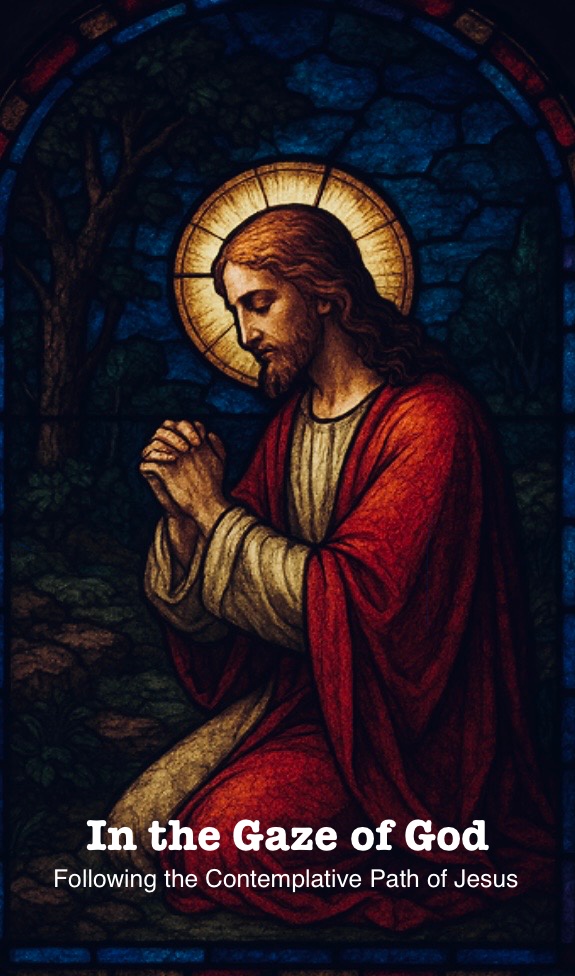
The idea of Jesus being relaxed does not mean that Jesus did not experience stress or real suffering. In the Garden of Gethsemane, Jesus faced the reality of the cross. He knew well what was before Him. Instead of trying to control the situation or find a way to run away, Jesus abided with the Father. From the Gospel text in Mark 14:36, we know that His response was to pray and He asked, “Abba, Father, all things are possible for you. Remove this cup from me. Yet not what I will, but what you will.” The surrender of His will to the will (and heart) of the Father is astounding. Jesus trusted that He was safe in the midst of danger. He did not shut down or runaway but stayed alert and listening to God the Father.
The contemplative nature of this prayer is rooted in the first words, “Abba, Father.” This is the first place in Scripture where God the Father is called Abba in prayer. Abba was a Hebrew word, more like Dad or Papa than the more formal “father” of the English language. It was an affectionate term and expressed intimacy. What Jesus had experienced in His own prayer closet (cf., Matthew 6) was displayed amidst great suffering and He responded in trust and loving obedience to God the Father.
The early church understood how “Abba, Father” reflected the uniqueness of Jesus’ connection with God. As a result, in both Romans 8:15-16 and Galatians 4:6-7, we read:
For you did not receive the spirit of slavery to fall back into fear, but you have received the Spirit of adoption as sons, by whom we cry, “Abba! Father!” The Spirit himself bears witness with our spirit that we are children of God. Romans 8:15-16
And because you are sons, God has sent the Spirit of his Son into our hearts, crying, “Abba! Father!” So you are no longer a slave, but a son, and if a son, then an heir through God. Galatians 4:6–7
Read back over those texts again. As our prayers are rooted, by the Spirit, in “Abba! Father!”, we relate to God as our Abba. We rest in the reality that we are children, held close to His heart. God the Father has His unfolding plans which we cannot fathom but as His children, we surrender in trust.
Read back over the verses from Romans and Galatians. Perhaps read them a second or third time, slowly. What do you notice? What is the Holy Spirit bringing to your awareness as it relates to trusting that you are safe?
Prayer: Abba! Father! I am Your child, held by You. Give me the grace to stay in Your loving arms and look at Your face in the midst of the chaos all around me. Amen.

Posted on March 11, 2026, in blog, In the Gaze of God. Bookmark the permalink. Leave a comment.
 desert direction
Leave a comment
Comments 0