Everything is Grace
The last year of my life has been one of the most difficult and yet one of the most glorious years of my life. When I first heard the word “cancer” as the doctor called to tell me the results of a CT Scan, my wife and I were stunned and reduced to silence. Only tears flowed as we began to process what it might mean.
After an invasive surgery to biopsy the baseball sized growth in my chest, I began six months of chemotherapy. To put it mildly, it has not been fun. And, it appears there is still more to come. However, not too far into the process, I began to experience a depth of reality previously reserved primarily in the realm of theory. In Soul Making, Alan Jones puts it this way:
“There is an unfinished quality about human beings that is both tragic and glorious: tragic because the openness and freedom of human identity is hard to bear; glorious because the openness and freedom corresponds to our deepest desire. Many people think of themselves as in some way finished.”
As I began to lose my hair, I began to gain the deep sense that we are indeed a mixture of tragic and glorious. Because of the created freedom that humans experience, we frequently opt to pursue some sense of being “finished” and “put together.” This is tragic because it is illusory and unattainable. Suffering can be an incredible gift because such illusions are shattered. To sugar coat suffering or to say that a cancer diagnosis is not so bad is to deny reality. However, there is something deeper to be experienced than favorable or unfavorable circumstances.
Suffering has a way of highlighting our “unfinishedness” and it is glorious because there is the opportunity to live our created design without the illusions that often plague us. When life is going relatively well, we might believe that we can be finished, that we can be independent. Those concepts are not only illusions but they are not consistent with our design as contingent, dependent beings. Our deepest desire is to use our freedom to connect with God … to abide with Him … to discover our true self in Christ.
Romans 8 famously asserts “there is nothing that can separate us from the love of God.” We often cling to that truth in a passive sort of way. We look at it passively in terms of intellectually trusting the concept that God loves us when suffering and loss is so painfully present. Beautiful words, but they might not necessarily transform the way we are interacting with things.
So, what does it really mean, “nothing can separate us from the love of God”? Foundationally, it means that He is not separate. He is not distant. Further, it means that if “no thing” can separate us, then “every thing” is a connecting point with God. This is not a passive concept but one that can usher us into a very active way of being in this world. If “every thing” is a place to connect, then experiencing God is always in the present tense. The present moment, as Jean Pierre de Caussade wrote, “holds infinite riches beyond your wildest dreams.”
Perhaps, those places of suffering and difficulty are actually great connecting points with God because we experience our need and desperation for God more fully in suffering than in the “pleasant” spaces of life.
However, we are frequently tempted to run from our sufferings instead of meeting God in them. In Exodus 14, the people of Israel traveled to the promised with the armies of Pharaoh on their heels. They begged Moses to go back to Egypt as they began to believe that they would die in the wilderness. Moses responded with, “The Lord will fight for you, and you have only to be silent.” Silence is an expression of deep trust in the midst of suffering, and it has a way of opening us to a different way of seeing. In James 1, we are challenged to be quick to listen and slow to anger and speech. In silence, we are able to see that our frailty and “unfinishedness” is actually our greatest asset rather than a liability. If anger and talking take precedence, we often never move past feeling we’ve been deprived in some way.
When suffering, the sensation of separation from “the good life” can be very real. Like the people of Israel, it can feel like death. Again, if nothing can separate us from His love and presence in our lives, then we can reinterpret these feelings as the experience of our need and desperation for God. The “good life” is Him.
So, everything is grace. Every thing is an opportunity to know and experience His love.
Do I believe that everything is grace? Is everything an opportunity to know Him more fully and deeply? On some days, I can say “yes” and on other days, I struggle but even in the struggle I know that there is more. Perhaps that is what hope feels like … trusting that there is more.
Benedictine monk David Steindl-Rast comments: “Can you be grateful for everything? No, not for everything but in every moment.” We cannot be and should not be grateful for things such as war, violence, or illness. It is not that the circumstance is a gift but in the moment, we can experience gratitude for what the circumstance offers, what it gives.
1Thessalonians 5:18 encourages, “Be thankful in all circumstances.” Notice that it does not say “for all circumstances.” Of course, but in each moment we can be thankful because each moment holds a wealth of riches.
As I continue on my journey with this illness, I am challenged to say, “This is the day that the Lord has made, I will rejoice and be glad in it.” (Psalm 118) The circumstances of the day might be hard but this day will gift me with another opportunity to know Him, and the more difficult the day … the more deeper the knowing.
I am grateful because everything is grace … everything is a pathway into what my heart most desires, knowing Him.
————————————————————-
Note: if you are interested in following my journey with cancer, you can follow my journal at mylifeline.org/tedwueste.
Advent and Cancer

I entered the Advent season this year in a way I could have never imagined. Just one month before Advent began (on November 3), I was under a CT Scan machine to determine the nature of a 4 inch mass in my chest discovered by x-ray only days before. The news came fast and furious: lymphatic cancer. Did I hear the words correctly? Really? Could the cause of my coughing and extreme fatigue really be cancer? Once the news settled in, it became apparent that an intense journey lay ahead.
After the initial diagnosis came a needle biopsy, a surgically invasive biopsy, a bone marrow biopsy, and numerous blood tests. Just two days before Thanksgiving, I had a port placed in my chest where I would receive chemotherapy. Then, hours later, I received the first round of chemicals poured into my body. Next, a two week wait, through days of side effects and days of normalcy, until the next round of chemotherapy.
I’ve noticed that waiting in the midst of pain, uncertainty, and longing are the hallmarks of a cancer diagnosis and the subsequent therapy. This is the Advent season lived out in a tangible, physical way. Advent is a word that means “coming” or “arrival” and it is a time of waiting for the arrival of Jesus at Christmas during the 4 weeks preceding December 25th. Of course, He arrived in the past and provided salvation through the cross and resurrection but entering into a period of waiting each year reminds us of our need for a savior and orients our hearts to let go of the trivial and grasp that which is most real, Christ Himself. Each day of our lives, we have an invitation to welcome Christ into our lives and Advent gives us eyes to see the invitations as well as the resistances.
In Advent, we are choosing to learn to wait. We are learning to allow the unresolved and the uncertain to open our hearts to true hope. In our modern world, we can so easily slip around the sides of pain and uncertainty through avoidance. We avoid through numbing ourselves with activity and excess and substances. We avoid through moving away from that which is painful. Advent is the conscious choice to stay in the waiting and it is there that we are confronted with our tendencies to avoid.
Of course, something like a cancer diagnosis affords the same opportunity but not through the avenue of choice. But then again, I’m learning that there are choices and invitations each day in the midst of a cancer diagnosis. I can choose to make cancer my identity or I can choose to see myself in light of the hope of a God who is with me. I can choose to worry about tomorrow or I can choose the gift of what today will bring, even in the midst of pain. Part of my spiritual practice each day is prayerfully asking, “What are You inviting me into today, Lord?” (Note: I am learning this and not very good at it … yet.)
In observing Advent as a part of yearly rhythm in my life with Christ, it seems that our gracious Father has prepared me deeply for this season of prayer and waiting.
Here are a few things I’m leaning into these days:
- Trust is not relying upon answers and certainty, but resting in the One who holds all things. He holds my life and in one sense, the details are none of my business. I do know that He is good and sometimes that’s all I know.
- I see His love in the little, hidden things that many might not see. On my most difficult days, it seems as though He winks at me with a card in the mail or the text of a friend in which they unknowingly share things that are deeply meaningful in my relationship with God. I feel His gentle touch in the song or truth that the Spirit brings to mind in the middle of the night when I can’t sleep. It is not the big things but the simple, quiet reminders that are so powerful.
- “The meaning is in the waiting.” This is the title of a great little Advent book by Paula Gooder. It is a reminder that waiting is not something to simply endure but a gift to unwrap. Waiting has its own meaning as it confronts us with our resistances to experiencing Christ in the now, not when our lives look the way we’d prefer.
- My identity is not as a cancer patient but as a child of God, His beloved. No circumstance or limitation defines me. On days when I feel like I can do nothing, I am reminded that I don’t have to do anything to be loved and valued. I have value that is independent of my ability to produce or contribute or even give back.
- I am truly learning to live day by day. I’ve never been so confronted by the reality that Jesus describes in Matthew 6, “Do not be anxious about tomorrow … sufficient for today is its own trouble.” I’m finding significant temptation in wanting to forget about today (especially when its painful) and move on to the next day, hoping that it will be better. No day is perfect and when I simply move on, I miss the gifts found within the imperfection of today. More than anything, it is His presence that is available today. Hope is about today … the hope and trust that He is at work, that He is present.
“Why am I in such a hurry to arrive? Yet how is it that, I’m grateful for this long and dusty road that is leading me back to loving union with my creator with my beloved. Above all, trust in the slow work of God. We are quite naturally impatient in everything to reach the end without delay. We should like to skip the intermediate stages. We are impatient of being on the way to something unknown, something new. And yet it is the law of all progress that it is made by passing through some stages of instability— and that it may take a very long time … Give Our Lord the benefit of believing that his hand is leading you, and accept the anxiety of feeling yourself in suspense and incomplete.” Pierre Teilhard de Chardin
“Loving God, I don’t like to wait. So I don’t wait to see the unfolding of your kingdom or to rejoice in the Savior you have given me, because I would have to relinquish control. Too often, I end up creating my kingdom rather than turning to thy kingdom. Impatient, I stray from you presence, grasping at things and people rather than letting you alone satisfy my deepest desires. You see, Lord, if I am really honest, while I believe in you, I don’t always trust that you will be there to pick up the pieces. This Advent, make my will one with yours so that I may put greater trust in true wealth – your saving presence – especially one the days when mine feels so impoverished.” Andrew Carl Wisdom, Advent and Christmas Wisdom
“Do not focus on what may happen tomorrow, the same everlasting Father who care for you today will take care of you tomorrow and every day. Either He will shield you from the suffering or His will give you unfailing strength to bear it. Be at peace, then, put aside all anxious thoughts and imaginations and say continually, ‘The Lord is my strength and my shield; my heart trusts I Him and I am helped. He is not only with me but in me and I in Him.’” Francis de Sales
Technology and Our Life with God

In our modern world, we find ourselves more distracted than ever. We struggle because we want to stay focused on what is important but we watch in seeming helplessness as technology draws and keeps our attention. Who among us hasn’t logged on to a social media site only to look up and realize we just spent 45 minutes on virtually nothing? Or, we find our attention constantly drawn to the beeps, bells, and ring tones of our smart phones.
At the core of who we are, we desire to live lives in which we are deeply loving God and others. What this requires is being fully present to others and living with an awareness of God’s presence. However, modern technology seems to clash with this desire constantly.
Social scientists have noted that many of us are actually addicted to our devices. The average American checks their cell phone every 20-30 seconds. Half of us check our cell phone first thing in the morning (66% of millennials) and last thing before going to bed. 75% of us never turn off our cell phones, and a growing number of people sleep with their cell phone in their bed. Leadership author and speaker Simon Sinek reports that the same chemical that is released in our brains through gambling, smoking, and alcohol is released when we engage our cell phones and social media. It simply feels good when we get a text or receive a “like.” We may experience the distractions and the addictions and feel powerless against these forces.
We may know that we have a problem, but the problem is not technology. Technology is nothing new. A technology is anything we utilize to make our lives easier. The challenge arises when we stop using technology and we become a slave to it. 1 Corinthians 6:12 says: “’All things are lawful for me,’ but not all things are helpful. ‘All things are lawful for me,’ but I will not be enslaved by anything.” (ESV)
So, what do we do? How do we interact with technology in a way that nurtures our life with God rather than distracts us?
I would suggest three practices that can transform the way we interact with technology.
- Examine your heart. Prayerfully ask God to show you the motives of your heart. What drives your use of technology? Are there forces at work that are leading to being “enslaved” to your devices? Is it needing to be more productive? Is it not wanting to miss out on what others are doing? Is it simply that you are suffering from an addiction to the endless rabbit holes of social media and google searches? As the Lord graciously gives insight, entrust your heart to Him. Allow Him to be your source of security, strength, and significance. For example, when I experience envy as I view a friend’s post from their month long vacation to Maui, it can be transformed into prayerful trust that He is enough for me!
- Create boundaries. We simply do not need to have our technology on all the time. It is not physically, emotionally, or mentally healthy. Learn to use “airplane mode” on your phone. Turn devices off at certain times during the day (meals, meetings, times of prayer, church, etc.). Make a decision to stop technology use at some point before going to sleep and only turn things back on in the morning after you’ve attended to your relationship with God. Be creative and talk about technology boundaries with your family and community.
- Practice meditative prayer. Research has shown that we are better able to battle the distractions of life (technology included) when we spend time each day in quiet, meditative prayer. I’ve found that simply sitting quietly, meditating on an aspect of God’s character as I let go of other thoughts and distractions works well. Bottom line: carve out time each day to be quiet and sit with God in an undistracted way. It takes time to learn to sit still, but it will transform your ability to be present throughout the rest of the day. Consider Psalm 62:1, “For God alone my soul waits in silence; from him comes my salvation.”
Technology is a gift to free up space in our lives to focus on what is most important.
Through intentional, prayerful practices, technology can remain just that, a gift, rather than a distraction that keeps us from what is truly important.
A Friday Called Good
It wasn’t so good for those who first experienced it. There was confusion, denial, anger, and despair. But now, in retrospect, we can see that goodness was dripping all over that day. At first glance, we never see the redemptive purpose in suffering. It is seemingly beyond us to consider that the horrific might actually be “good” in some sense.
So, what is “goodness”? What does it mean that something is good versus bad? The question itself is part of the problem we face. We tend to define things in black and white terms. Things are either this or that. People are either in or out. We perceive either love or hate. Polarities are helpful at times but they can only get us so far in the real world.
Most of life is a mixture of such polarities and requires a kind of navigation that reflects this reality. When we lose a job or a relationship, it hurts and at the same time it may have goodness all over it. The hurt, the shock, the confusion can push us into seeing only part of the story. Our initial, impulsive responses to most of life are geared toward the quick categorization of things as good or bad. It is with a slower response that we can perceive and enter into the complexities, and therefore appreciate the good that can be found in all things.
The sainted Carmelite nun, Therese of Lisieux wrote, “All is grace.” This came from a young woman who spent most of her years sick and died at the young age of twenty-four from tuberculosis. She saw all as grace because no matter the situation, God was present and offering Himself in love.
So, again, what is good? In the purest sense of the word, God alone is good. Jesus made this very clear in Mark 10:18 when He responded to the rich young ruler by saying, “Why do you call me good? No one is good except God alone.” He proceeded to challenge this man to letting go of all his earthly possessions (something that didn’t seem good at all) in order to have “treasure in heaven” which is God Himself (something that is very good, indeed the epitome of good).
In Micah 6:8, the statement is made, “He has told you, O man, what is good; and what does the Lord require of you but to do justice, and to love kindness, and to walk humbly with your God?” Goodness? Put simply is to walk humbly with God. It is look for God and at God in all situations. In the worst of situations, He is present and available.
As we consider this Friday in which Jesus died, it is wise to view it as the horrible day in which the God of the universe suffered a cruel, torturous death. It is important to feel the horror and hold close the scandalous nature of what happened. Then, in the pain and the suffering, look to God and see the goodness, experience the grace of a God who suffered so that we would always be able to experience that “all is grace.” Because of Jesus’ death, we are never separated from Him … and that is very, very good.
“This is Us” and Unraveling the Past

Over the last few months, I have been watching This is Us, a television show, which follows the lives of three adult siblings and introduces various vignettes from their childhood in each episode. The topics addressed and situations depicted range from hilarious to poignant, to difficult to watch as well as everything in between. Almost every week, I find myself tearing up as some element of the plot unfolds.
Several weeks ago as I watched an episode, it occurred to me that the reason I am so moved is because I see the characters as people who have a story. Present pain or joy or the need for self-discovery are all based upon earlier formation. So, rather than seeing a character as obstinate, I view them as wounded. Rather than seeing a character as odd, I view them as adorably quirky. Each adult has a story filled with love and pain and mystery. And, I am reminded that I have a story that has shaped me. As Kate, the sister who goes to a weight loss camp, confronts the pain of losing her father, I was struck deeply by the pain of loss. It occurred to me that so much of our adult lives is about the journey of finding healing from the hurts or exploits of growing up.
As we navigate our childhoods and adolescent years, we develop patterns and habits that we believe will do two things: protect us from pain and increase pleasure. These protective mechanisms can range from careers we choose to ways of relating sexually to the world around us. Our protective walls may be permeable to an extent but there are still walls designed to keep out pain and let in pleasure.
The first part of our lives is about building a container for our lives … a safe place where pain and pleasure are dealt with according to the plan. The problem is that our protective measures really only protective us from love and from experiencing a depth of relationship with God. At some point, we realize that we are in a box that is more stifling than protective. We see that our lives have served to protect us from the only thing that really matters … love.
So, then, the second half of life is about allowing those walls to fall. The second half of life is more descriptive of a process than strict chronological markers. Nonetheless, the western phenomenon of a “mid-life crisis” finds its location in the realization that our protective walls have not allowed for the telling of the whole story of our lives. Crisis can open to tragic choices or it can open to opportunity … an opportunity to let the walls fall down and open to the wide-open spaces of God’s grace. Letting the walls fall down takes courage. Opening to love requires first receiving love.
It has often been said that you can’t put God in a box, but the reality is that Jesus comes and gets in our boxes with us. He meets us where we are when we put our faith in Him to be our Savior. The promise of salvation after this earthly life is a gracious gift but the gift is not only for life after death but for life before death. Once inserted into our lives, Jesus sits us with us like a Trojan horse behind the walls of a fortified city. He begins to say things like, “sell all that you have and follow me” (Luke 18:22) or If anyone would come after me, let him deny himself and take up his cross daily and follow me.” (Luke 9:23) When we are firmly devoted to our walls, we are able to explain away such encouragements from Jesus and contextualize them in our strategies for protecting from pain and increasing pleasure.
However, when we start to see that the protective walls aren’t really furthering our plan, we begin to truly open our hearts to the message of Jesus. We see that our lives do indeed “consist in more than the abundance of possessions.” (Luke 12:15) We grasp that we were made for more than this world can ever offer. It is then that the opportunity exists.
For many of us, we smell the opportunity wafting through our soul and we ignore it. Perhaps we believe for a moment that we can still give this self-protective game a go of it. Or, perhaps we are just too afraid at the current time. The good news is that Jesus stays put simply whispers over and over that we can drop the walls and open to life.
Here’s the dangerous part that dropping the walls requires … the walls only go down as we unravel the story that put them up in the first place. For many, this is where we stop. “No,” we say, “I don’t want to revisit that. Can’t I just move on?” We know the answer but might reject admitting it to ourselves.
Jesus offers redemption but we have to go and find all the pieces of our story that need to be redeemed. Jesus is not a magician who magically passes a wand over our lives and erases our memories. No, He is instead a man of sublime miraculous power. Instead of wishing things away, He takes the real stories of our lives and heals the actual story as we give him one piece at a time, as we let Him have each part. This is frequently a process of stops and starts but He never seems to be in a hurry. He patiently waits and gently whispers again and again, “you can trust Me. I love you and will never leave you.”
In his book, Invitation to Love, Thomas Keating writes:
“Our personal histories are computerized, so to speak, in the biocomputers of our brains and nervous systems. Our memory banks have on file everything that occurred from the womb to the present, especially memories with strong emotional charges. In the first years of life … already these computers are developing emotional programs for happiness – happiness at this stage meaning the prompt fulfillment of our instinctual needs. By the time we come to the age of reason and develop full-reflective self-consciousness around the age of twelve or thirteen, we have in place fully developed emotional programs for happiness based on the emotional judgments of a the child.”
What if the pain we seek to avoid and the afflictive emotions we experiences were invitations to be received rather than annoyances to be avoided? What if the unravelling of our stories began with sitting with Jesus in those places, allowing Him to hold each part and gently piece things together again.
Let me suggest four invitations that allow us to unravelling our past:
- The Invitation to Notice
As we simply learn to notice what we are feeling, we can begin to face the realities of our internal lives.
“As we try to understand the process of change, we must realize that deep change comes about less because of what we try to do and how hard we try to do it, and more because of our willingness to face the realities of our own internal life. Personal integrity, a commitment to never pretend about anything, is prerequisite for change from the inside out.” Larry Crabb
“As we begin the difficult work of confronting our own unconscious motivations, our emotions can be our best allies. The emotions faithfully respond to what our value system is – not what we would like for it to be, or what we think it is. Our emotions are perfect recorders of what is happening inside; hence they are the key to finding out what our emotional programs for happiness really are.” Thomas Keating
As we begin to notice, we ask the Lord to show us what the emotions are meant to reveal.
- The Invitation to Release
As we acknowledge those emotional programs for happiness, we are then invited to release them … to let them die. Jesus graciously shows us, as we prayerfully listen, how to let each wall fall down. It might be through self-denial or it might be through finding your voice in a relationship.
- The Invitation to Trust
As we begin to release, we can experience feeling naked. The old walls were, if nothing else, home. They were comfortable and known. What is coming is unknown so there is an invitation to trust. In the Garden of Eden, the temptation was to know. Eating from the Tree of the Knowledge of Good and Evil was viewed as knowing … power (make one wise), pleasure (good for food), and position (delight to the eyes). Eating from everything else was trusting God which meant living with mystery. Most reject mystery and “unknowing” but it is the essence of recovering the life we were meant to live.
- The Invitation to Rest
Finally, we are invited to rest. We get to rest in the truth of who we are in Christ, made in the image of God. The image of God is relational trust, love, and submission. God is love because is Trinity. When we rest in love, we no longer have to seek for anything outside of ourselves. We can become the mountain that sits quietly and majestically. Storms may pass, but we are not the weather, we are the mountain.
Loving God Slowly

Photo Credit: fatboyke (Luc)
Last week, I had the privilege of retreating with a group of leaders from our church. We went to a mountain cabin in the cool pines of Arizona where an afternoon rain caused the temperature to plummet into the 60s. Coming from the desert environs of Phoenix where the summer lows might drop into the high 80s, it was a welcomed change.
As refreshing as the temperatures were, even more refreshing was the time spent in quiet reflection and prayerful listening. During a time of group sharing on the last day of our retreat, one of the leaders made a statement that I am still pondering. He said “I am learning to love God slowly.”
“Love God slowly!” As I heard these words, I immediately sensed that He was on to something and the awkward phrasing caused me to stop and reflect on what was meant. English is my friend’s second language which likely contributed to the unique expression, but he was doing his best to put his experience of God into words.
Several things have occurred to me as I continue to ponder my friend’s words:
- Our command of a particular language can actually be a barrier to experiencing God. There is no way that words can contain God and certainly not our experience of Him. When we depend too heavily upon words to understand the gracious movements of God in our lives, we might just be limiting our understanding and simply settling for old categories or overly simplistic ideas that can no longer describe Him. There are times when we have an experience of love and/or awe and we say, “I don’t know how to put that into words.” Perhaps, there are times when we just need to sit with God and refrain from the attempt all together. Simply sitting in silence can be a reminder than God is bigger than our words and concepts and ideas. Interestingly, it was from a time of quiet, wordless reflection that my friend emerged with the phrase “love God slowly.”
- Then, of course, the very idea of “loving God slowly” is so profound. We can’t love fast. We just can’t. It’s not possible. Speed keeps love from being deep and thorough. Love lingers and savors and enjoys. So, loving God slowly means that we stop and give ample time to listen and notice what is really going on. How much do I miss because I am simply too busy and too hurried to perceive? As a teenager, college student, and young married adult, I moved so fast and missed much in my surroundings. Living in the Phoenix area, I missed that there are mountains all around. The Phoenix Mountains Preserve (right in the middle of the city) is the largest city park in the United States, but I missed its beauty and grandeur. My wife and I moved away for 15 years and upon moving back in my forties, I’ve found myself thinking on more than one occasion, “Were those mountains there when we lived here before?” It is possible for there to be profound, amazing, beautiful realities right before our eyes and not see them. It requires moving slowly. As I learn to love God slowly, it means that I can see and experience His profound presence in my life in deepening ways.
- There are certainly benefits to moving fast but do they outweigh the benefits of moving slowly? Teilhardde Chardin, the noted scientist and Jesuit mystic, said it well: “The physical structure of the universe is love.” If that is true, the going fast keeps me from love and therefore the very nature of the universe. God reveals Himself personally through the Holy Scriptures, through my intuition, and through His creation. I can miss all of this running too fast. The benefits of going fast are not only outweighed by loving slowly, they are obliterated.
- As I considered further the concept of slow love, a verse from 1 Corinthians 13 kept coming to mind: “love is patient.” Of course, patience is most frequently thought of as a response to a negative circumstance. The object of my love is irritating, so I need to be patient. But, could this also speak of a more positive application of love? Love, in its very nature, is slow which leads to waiting through a tough situation but also means that I wait for intimacy to develop. I wait and am slow because the deepest realities of love and life and God won’t just jump out at us. Love is patient also in a very positive sense. In the Song of Solomon, there is a refrain that is threaded through the love song: “do not awaken love until it pleases.” The idea is that we wait for love to develop. Intimacy doesn’t happen in an instance. It is a vast reservoir that must be accessed and explored over time.
- Finally, I thought about how often our concepts and experiences of God are frequently marked by platitudes and borrowed phrases. “God is good … all the time.” While certainly true, that phrase likely doesn’t come from a place of personal intimacy for many who utter it. Intimacy and depth of relationship produce nicknames and “pet phrases” that no one else knows. The words and concepts that emerge from intimacy are likely understood by no one else, or at the very least, they sound strange. I have nicknames and phrases for and with my wife that twenty-five years of marriage have produced. What seemingly awkward phrases do I share with God? What is His name for me? Revelation 2:17 indicates that God’s gives a new name (“a nickname”) that is only known by us as we walk faithfully (“slowly”?) with Him.
Ponder this idea of loving God slowly. What might that mean for you? How can you slowdown in order to walk in step with the very nature of the universe? Reflect upon one way you can love God slowly today.
Prayer: Father God, may I love you slowly. Give me the eyes to see you as I slow down and take notice of you … as I linger at your throne in prayer, not to gain anything but to enjoy what is already ours in relationship. You are so worthy of the best of my time. Thank you for loving me slowly and being patient with the process you’re continuing to graciously unfold in my life. Amen.
==================================
Resource: An Unhurried Life, Alan Fadling
God Can’t Fix You

God can’t fix you. Ok, perhaps a better way to say it is that God isn’t interested in fixing you. I realize that might sound strange to but please hear me out. Clearly, God promises to deliver us (Col 1:13-14) and to give us life (John 10:10). Some have even suggested that God has a “wonderful plan” for our lives. However, most frequently we interpret these ideas of deliverance and life and plans on our own terms rather than God’s terms.
A simple survey of our lives should create enough cognitive dissonance to prod us in the direction of reexamining our presuppositions about the nature of how God is present in our lives. He simply doesn’t “fix” all the areas of discomfort and pain and suffering in our lives and the lives of those we love. We lose parents to cancer and suffer with chronic illnesses. We suffer the loss of friends and often feel a sense of loneliness no matter how many people are around us.
For some, the solution is believed to be more prayer or trust or obedience. The argument goes like this: “if I just have enough faith, then God will bless me.” Or, “if I live purely before Him, things will go well in my life.” The problem with this kind of thinking is it is based more on “magic” than the reality of who God is.
To be sure, we all want magic. We’d love to have the formula to make pain go away and live happily ever after. Just as Blanche said in A Streetcar Named Desire, “I don’t want realism, I want magic! Yes, yes, magic. I try to give that to people, I do misrepresent things. I don’t tell truths. I tell what ought to be truth.” Part of the allure of “magic” is that it puts us in control but in our pursuit of magic, we have to deny reality. And, it is in that denial that we isolate ourselves from what we truly desire and need.
Reality is that God doesn’t usually fix things (at least not on our terms). In John 11, Jesus is alerted to the fact that His friend Lazarus is ill and instead of running quickly to fix the situation, he waited and took His time to get to his friend. In the interim, Lazarus died and his sister Martha said, “Lord, if you had been here, my brother would not have died.” Of course, if you know the rest of the story, you realize that Jesus resurrected Lazarus. It is important not to skip too quickly to the resurrection part because it is in Jesus’ waiting that we are alerted to the fact that God is not a “fix it” man. He does bring healing and renewal and restoration that is complete but what is the nature of that resurrection?
Larry Crabb astutely made the observation, “If God was committed to my comfort, He’s not doing a very good job. Maybe He’s committed to something else.” When we consider the nature of the resurrection, we see that God is committed to restoration of our relationship with Him … that loving, dependent fellowship that we have with the Trinity. In Ephesians 1, Paul prayed that we would know “what is the immeasurable greatness of his power toward us who believe, according to the working of his great might that he worked in Christ when he raised him from the dead and seated him at his right hand in the heavenly places.” (vv. 19-20) God is committed to us knowing resurrection power and what is the nature or teleological end of that power? It is loving, intimate fellowship with God.
And so, our pain and “unfixed” life situations should alert us to the idea that God has purposes deeper and more significant than giving us lives that are comfortable and without distress. Whether it is physical pain, relational hurt, or spiritual temptation, it seems clear that hurts and weaknesses can not only lead us into God’s purposes but also be necessary for what He has in mind.
In the Hebrew Scriptures, Job is presented as a blameless, God fearing man, and God allowed Him to be afflicted and tempted. In the New Testament Scriptures, Paul was afflicted with a “thorn” and God refused to take it away after a season of prayer. In his refusal, God shares what He’s committed to: “My grace is sufficient.” God desires for us to be in a love relationship with Himself and if he takes away all the pain, we’ll seemingly have no need for Him. Years ago, a family friend gave our family a framed statement that she found on her father’s desk upon his death:
“When we are helpless to change the unchangeable,
this is the hour that God in His promise becomes so real.
I’m always reminded that if we could control life and death,
seemingly we would have no need of Him.
May His presence guide you in these hours and days ahead.”
One of the most difficult areas of exploration is the area of lingering temptation and sin in our lives. We might ask: why can’t God just take all of this sinfulness away once and for all? In her book Extravagant Grace, Barbara Duguid puts it this way:
“God thinks that you will actually come to know and love him better as a desperate and weak sinner in continual need of grace than you would as a triumphant Christian warrior who wins each and every battle against sin. If the job of the Holy Spirit is to make you more humble and dependent on Christ, more grateful for his sacrifice and more adoring of him as a wonderful Savior, then he might be doing a very, very good job even though you still sin every day.”
So, God doesn’t “fix” us but He graciously extends resurrection power that enables us to do life with Him. We are able to walk through any storm or hurt or temptation or trial because He is with us, reminding us that His grace is sufficient.
Quite frequently, we get derailed because it is not the voice of love we hear but the voices of entitlement and pride. Henri Nouwen reminds us: “Only by constantly attending to the inner voice can you be converted to a new life of freedom and joy.” (The Inner Voice of Love) We must ruthlessly and consistently eliminate messages that suggest anything other than the truth that God is absolutely, passionately, intimately in love with us and that He is present.
A few years before he left this earth, Brennan Manning beautifully suggested the following: “I am utterly convinced that on the judgement day, the Lord Jesus is going to ask us one question and only one question: did you believe that I loved you? that I desired you? that I waited for you day after day? that I longed to hear the sound of your voice?”
Are you listening for His voice of love (that His grace is sufficient) or are you still listening to the voices of comfort and accomplishment and success and appreciation?
The voice to which we listen shapes our expectations and desires. Let Him shape your heart and mind! Today, spend a few moments attending to His voice of love. Let Him speak His words of love over you (Zephaniah 3:17). Simply select a verse or phrase from Scripture which speaks of His desire for you and sit with that verse for 10 minutes … reflect on it, meditate on it, talk to God about it … as your mind drifts, simply come back to that verse or phrase.
So, fix us? No. Restore us into a deep, abiding relationship with Himself? Yes. Don’t ask Him to “fix” you, ask Him to draw you ever closer to His heart! If taking away a hurt or an illness or a temptation can best accomplish that purpose, He’ll do it, but don’t ever mistake His intention for you or forget how He longs to know and love you.
After Resurrection … an Easter Poem

After resurrection, there is peace
Strivings can cease
Breathing can slow
After resurrection, there is peace
A peace that surpasses understanding
A peace that calms my fears
After resurrection, there is peace
All things are made new
The promise of hope is real
After resurrection, there is peace
Selah
Hallelujah
On the evening of that day, the first day of the week, the doors being locked where the disciples were for fear of the Jews, Jesus came and stood among them and said to them, “Peace be with you.” (John 20:19)
Last Words: Day Six
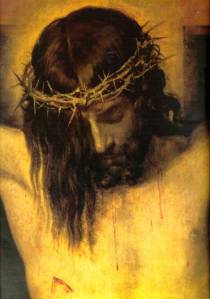
“Father, into your hands I commit my spirit!” Luke 23:46
The last words of Jesus on the cross are a simple prayer of entrusting Himself to the Father. In the midst of His suffering and as it was coming to an end, His approach was trust. 1 Peter 2:23 describes Jesus: “When he was reviled, he did not revile in return; when he suffered, he did not threaten, but continued entrusting himself to him who judges justly.”
The just judgment of God was a comfort to Jesus on the cross. As He certainly felt the sting of insults and the shame of hanging naked on a cross, He continued to trust. It is tempting to think of a “sanitized” savior who suffered quickly and quietly but the evidence is that Jesus was tortured and villainously mocked. His relationship with the Father and the Spirit were His comfort and focus as “in every respect he has been tempted as we are, yet without sin.” (Hebrews 4:15) This statement from the writer of Hebrews tells us at least three things:
- Jesus was sinless which is why “He is the propitiation for our sins, and not for ours only but also for the sins of the whole world.” (1 John 2:2) The writer of Hebrews shares that we can hold fast our confession (our trust in Christ) because He is a great high priest. He made the sacrifice to end all sacrifices. (cf. Hebrews 9:26-27) Our relationship with God is secure and safe.
- With such security and safety, we can draw near to the throne of grace (Heb 4:16) and find mercy and grace in our time of need. What Jesus did on the cross is truly gospel (good news) because the truth is that we are always in need of love and acceptance. In Jesus, we find refuge for our souls.
- Finally, the first part of Hebrews 4:15 shares that “we do not have a high priest who is unable to sympathize with our weaknesses.” He became weak and knows what it is like to feel need and vulnerability. The cross is both example and entrance. It provides entrance to the throne of grace and at the same time provides the example for how we approach.
These last words of Jesus (“into your hands I commit my spirit”) is a quote from Psalm 31. In addition, the words “I thirst” and “My God, why have you forsaken me?” also come from Psalms (69; 22). What we see in Jesus’ example is that the Psalms are intended to be a prayer book. From the cross, Jesus could have prayed anything and it would have been right and pure but He modeled that the Psalms are a gift from God to shape and guide us in prayer. At times, our prayers can be flimsy and self-centered but the Psalms give structure and theological, spiritual integrity to our communing with God.
In writing about the Psalms, the reformer John Calvin said: “I have been wont to call this book, not inappropriately, an anatomy of all parts of the soul; for there is not an emotion of which anyone can be conscious that is not here represented as in a mirror.” The beauty is that the Psalms give us words for what is happening inside of us and then a trustworthy structure for talking to God about the honest contents of our hearts.
For millennia, the Psalm have been prayed in group settings as well. Episcopal monk Br. Mark Brown (SSJE) explains the value: “Sometimes we Brothers are asked why we recite all the Psalms–even the cursing Psalms. Praying the Psalter is a stylized, poeticized, set-to-music way of lifting up the whole human condition, the full range of experience from darkest night to brightest day. It’s a way of praying with and for the whole of humanity.”
The Psalms demonstrate that the Father desires all of us – the confused and the joyous, the angry and the content, the doubting and the trusting parts of us. So often, we bring the contents of our hearts to our self (our evaluating and deliberating and cleaning) or to others for sympathy or advice. But, Jesus demonstrates a better way: we can bring our despairing questions (“My God, why have your forsaken me?”) and our frustrations (“I thirst”) and our trust (“into your hands I commit my spirit”) to God in prayer. As we do, we are shaped and formed by His presence in our lives.
Today, on this dark day between the crucifixion and the resurrection, what do you need to bring to Him? Pray through Psalm 139 – acknowledging that He knows you and is present with you (v. 1-18), entrusting your anger and hurt to Him (v. 19-22), and asking Him to search your heart (v. 23-24).
An additional prayer to pray throughout the day: Into your hand I commit my spirit; you have redeemed me, O Lord, faithful God. (Ps 31:5)
Last Words: Day Five
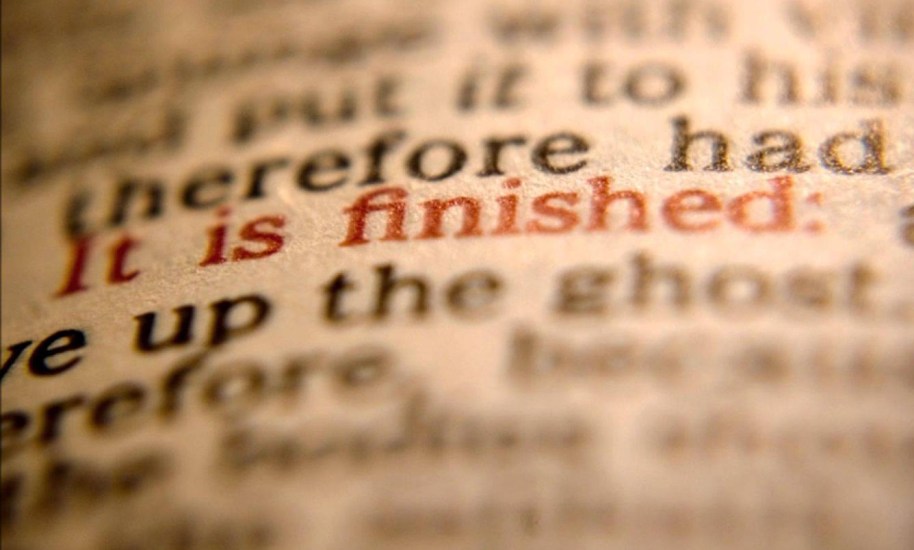
“It is finished.” John 19:30
We live in a world where so much feels “undone” and incomplete. Even more, things are chaotic and unpredictable. As a result, we can internalize our environment and unconsciously believe that it reflects deepest reality. The result is a generalized existential angst in which we ask the questions: can any of this really mean anything? Does all the chaos have any meaning at all? Most often residing deeper than our awareness, this anxiety fuels a constant search for meaning through accomplishment, accumulation, and affection. And so, we flit around frantically …
Pastor Arthur Simon comments that: “Ours is a restless culture. Life has become excessively busy for a large portion of the population. Stress is almost built into our body clocks. I am not a fast driver, probably slower than most. But sometimes I find myself hurrying to get somewhere—switching lanes, passing traffic, going through yellow lights—when it occurs to me that the only thing putting pressure on me to rush is my own state of mind…. Our wants are constantly expanding, and our income usually lags behind. More hours to work, more things to do, and more places to go create pressure. Far from producing a sense of inner peace, this style of life nurtures a spiritual void.”
The next to last words Jesus utters on the cross are: “It is finished.” A simple word in the Greek text of John 19: tetelestai. The verb tense speaks of something that has been accomplished with results that are ongoing! What Jesus accomplished on the cross has effects that are in force and active and real today. And, what did He accomplish? Just the night before the crucifixion, Jesus sat in the Garden of Gethsemane and prayed, asking God the Father if there was another way. Faced with prospect of such suffering, He humbly asked one more time: “Father, if you are willing, remove this cup from me. Nevertheless, not my will, but yours, be done.” (Luke 22:42) What was the task that Jesus had finished? In a word: redemption.
for all have sinned and fall short of the glory of God, and are justified by his grace as a gift, through the redemption that is in Christ Jesus, whom God put forward as a propitiation by his blood, to be received by faith. (Romans 3:23-25)
What this means for us is that “it is finished” – our search is over. There is meaning and grounding in the midst of all the chaos and uncertainty of the world. Jesus’ death answers the questions. The meaning of our existence is relationship with God and Jesus provided for our return. We can let go of our frantic pace and desires to fill the void. Our deep longing for purpose and substance and meaning has been met in Christ. Yet, how often do believers in Jesus still live out of that restlessness produced by anxiety rather than live out of the rest produced by knowing that “it is finished”?
In 1 John 4:18-19, we learn that: “there is no fear in love, but perfect love casts out fear. For fear has to do with punishment, and whoever fears has not been perfected in love. We love because he first loved us.” The generalized anxiety that we feel seeks for meaning, and at deep places in us, we wonder if the chaos and uncertainty is punishment. We ask: did I do something wrong? How can I atone? The love and reconciliation that we have in Jesus meets those fears head on and takes away our shame.
At our core, we long to be clothed and covered, safe and secure but this world sends us on a wild goose chase. The hope of things being “finished” is expressed beautifully in the words of Jesus in Revelation 3:18 that He has “white garments so that you may clothe yourself and the shame of your nakedness may not be seen.” The theme of being “clothed” is found in 2 Corinthians 5 as well:
For in this tent we groan, longing to put on our heavenly dwelling, if indeed by putting it on we may not be found naked. For while we are still in this tent, we groan, being burdened—not that we would be unclothed, but that we would be further clothed, so that what is mortal may be swallowed up by life. He who has prepared us for this very thing is God, who has given us the Spirit as a guarantee.
So, we have the Spirit to remind us and nurture within us a sense of calm and peace and love in the midst of the chaos. Today, take a few minutes throughout the day to rest in the reality that it is finished, that His love for you is deeper and more real than what you see around you. Experience the reality that the search is over as you pray this simple prayer:
Father, thank You for meeting my fear with your love. Jesus, thank You for suffering for me that I might be reconciled to God. Holy Spirit, clothe me with the knowledge that I am safe and secure no matter what goes on around me. Amen.
 desert direction