Let Every Heart Prepare Him Room: Waiting, Dec 5
 He humbles our hearts as we wait (Advent week 1 day 5).
Waiting can be wearying if we are simply waiting as an exercise of our will power. However, the Biblical concept of waiting is not a “grit your teeth and bear it” kind of thing. It’s a joyful resting in the goodness and grace of God. We might not see His goodness and grace in our present circumstances, but this restful waiting unlocks the deep truth that He is at always work and He is always present in our lives.
Author Paula Gooder encourages the spiritual discipline of waiting as she writes:
“Waiting draws us into a different way of being that does not rush to easy answers – that often have complex consequences – but takes account of not just our own welfare but that of all those around us. Waiting involves seeing differently and recognizing that quick answers are not always the best ones.”
The answers that we can rush into often work at a subconscious level. When we can’t see God at work, our deep heart may assume that He isn’t at work. Consequently, we feel this urge to take charge. Our world is rife with “wisdom” that we have to take charge and seize the opportunity. That narrative seeps into our souls. The result is that we put ourselves in the driver’s seat and reduce God to a kindly repairman who will keep our car running.
Thankfully, God is patient with us and He has bigger plans for us. He desires for us to live in a trustful rhythm where He is in the driver’s seat and we are His servants, His friends. Waiting humbles us and reminds us of our created design which is also our greatest joy.
In the New Testament Epistle of James, we read the challenging counsel:
”Be patient, therefore, brothers, until the coming of the Lord. See how the farmer waits for the precious fruit of the earth, being patient about it, until it receives the early and the late rains. You also, be patient. Establish your hearts, for the coming of the Lord is at hand.” James 5:7-8
The challenge? Be patient … wait. The context of this challenge is looking at the “rich” who use their wealth for themselves. We may not, by definition, be rich but there is an attitude of self … self-preservation, self-promotion, self-protection … that can be a part of our lives. The lie is that we can or even should be the master of our world. To that attitude, the counsel is: be patient. Why? Because when life seems out of control (i.e., “where is God? Does He even care? Is He involved here?”), our temptation is seize the wheel. The counsel? Be patient. Wait. Why? Two reasons:
- The coming of the Lord is at hand (or, near). The idea is that He is involved. He is present. He does have a plan. So, be patient …
- He is at work. The “early and late rains” reference is often lost on a modern audience. The early and late rains are a symbol of God’s provision and a farmer’s dependence upon something outside himself to take care of things. The people of Israel were geographically and meteorologically dependent as they raised crops. The contrast was the farming of the people of Egypt (and the people of Israel experience this when slaves Egypt) in which they built irrigation canals. They used water from the Nile and other rivers anytime they desired. They were in control. God’s counsel here is that we can patient because He is in charge and we can trust. He will provide.
Why depend upon God if we have our own resources? Because living this way is indeed our created design and only waiting will usher us into a place of dependence. The “established heart” in James 5 is a strong heart which is humble because it is shaped by hope in God – not hope in self. The illusion of having our own resources and trusting in them is that it makes us strong. The deep truth is that it makes us weak because it stresses us and converts us into something we were never designed to be …
Spend a few minutes with the Lord, asking Him: in what ways am I like a “rich” farmer? When am I tempted to build my own irrigation ditches rather than trust that God is present and that He is at work?
Finally, express your trust and dependence as you pray:
Gracious Father, humble my heart as I wait on you. Give me the strength to stop and wait so that you can be the One who saves me. Give me eyes to see my nakedness today but then to trust that You alone can clothe me. Use your Word, the world around me, and the words of others that I might see You alone as my savior all the day long. Amen.
Note: we look at “waiting” for another day and then move into the next part of “preparing room” which is the amazing truth that He softens our hearts as we listen.
Let Every Heart Prepare Him Room: Waiting, Dec 4
 He humbles our hearts as we wait (Advent week 1 day 4).
The receiving and giving of gifts is inextricably linked to the Christmas season, and Advent is a time of learning to wait for the good gifts of Christmas. Children often make the season about getting and having as they impatiently obsess about what gifts they will receive and how soon they can be opened. The mature, however, understand that gifts are always about relationship, trusting in the nature and timing of the gifts to be received.
The discipline of waiting prepares our hearts to receive the good gifts that God gives us. When we are impatient, we are looking at life and God on our own terms … seeking to meet our needs according to our definitions and our timing. Waiting slows us down and humbles us, reminding us that the true gift is the giver Himself … One who loves us deeply. When our focus becomes the giver, we are able to receive His provision not as a deserved right but as a gracious gift that perfectly suits us.
When we are suffering or in need, we often clamor and complain but God’s counsel is that we become “quick to hear, slow to speak, slow to anger.” (James 1:19) Why?
Because “every good gift and every perfect gift is from above, coming down from the Father of lights with whom there is no variation or shadow due to change.” (James 1:17) He always gives and provides exactly what we need and frequently there is a waiting period. Waiting creates a humility in our hearts that gives us fresh eyes to see His gifts that have often been present all along.
We think we want miracles and change and action but what we desire in the depths of our hearts is Him. He will let us wait so that we have the best opportunity to see and appreciate Him as our gift. One of the challenges in our world today is that we don’t have to wait. We can use a credit card to buy our way out of a tough situation. We can get a new job and move on to escape suffering. We can jump on a plane and be on the beach in an hour. The list could go on, but the reality is all too often we simply don’t wait for the good gifts that He brings.
Again, what are His gifts? In Luke 11:1-13, Jesus asks several questions to lead us into understanding how He works:
“What father among you, if his son asks for a fish, will instead of a fish give him a serpent; or if he asks for an egg, will give him a scorpion? If you then, who are evil, know how to give good gifts to your children, how much more will the heavenly Father give the Holy Spirit to those who ask him!”
We seek and ask for specific kind of provision and He not only gives but gives better than we even know how to ask. And, again, the gift is His presence in the Holy Spirit. In Psalm 40, David cries out: “I waited patiently for the Lord; He inclined to me and heard my cry.” David waited and realized that the Lord “inclined and heard” … He was present.
Do you trust that His presence is the gift above all gifts? Better than life itself? Waiting only makes sense in light of this reality, and learning to wait opens our heart to this gift above all gifts. And, the beauty is that we experience this gift in our waiting and then are able to receive anything else as a function of relationship, not rights. Our expectations change. Our prayers change. We change …
John Ortberg comments that:
“What always drives us, at the soul level, is that if I believe I cannot trust God for the satisfaction of my soul, then I will take my soul’s satisfaction into my own hands. I may not acknowledge that even to myself.”
Today, look for the gift of His presence in your life. Set an alarm on your phone or watch or computer for several times throughout the day. When the alarm goes off, stop and ask: “how am I seeing the gift of His presence today?” Ponder, acknowledge, thank Him, and then pray the following:
Gracious Father, humble my heart as I wait on you. Give me the strength to stop and wait so that you can be the One who saves me. Give me eyes to see my nakedness today but then to trust that You alone can clothe me. Use your Word, the world around me, and the words of others that I might see You alone as my savior all the day long. Amen.
Let Every Heart Prepare Him Room: Waiting, Dec 3
 He humbles our hearts as we wait (Advent week 1 day 3).
Singing the song “Silent Night” at this time of year can be a deeply moving experience. The very words silent and holy used to describe a singular evening draw us into the sacred drama of God the Son entering human history. There is something about the holiness of the moment that silences us. When we encounter the holy, there are not words that can adequately describe. Silence ends up being the perfect language.
Indeed, silence has been called the first language of God. In 1 Kings 19, it was the “sound of silence” which elicited awe and humility from Elijah’s heart. Silence takes away the pretense that noise often affords our hearts. When things are noisy, we can hide and pretend behind the clamor and the clanging. Our explanations and defenses are laid down in the arena of silence, leaving us in the purity of just being before a good and gracious Savior. It can be scary but it is purifying and full of awe.
A moment of silence on Christmas Eve is beautiful but a regular practice of silence ushers us into a way of living that transcends circumstance and makes us aware of the holy all around. The response to a holy moment is silence, but equally true is that silence can gives us eyes to see the holy.
As we consider learning to wait in order to humble our hearts, silence plays a huge part. In Psalm 65, King David cries out:
“For God alone my soul waits in silence. For God alone, O my soul, wait in silence, for my hope is from him.”
Robert L’Esperance, one of the brothers of the Society of St. John the Evangelist said:
“Advent is a time to look for ‘desert places’: the place of solitude, the place of true silence in which we can become fully awake to our sin and God’s forgiving grace which alone can heal it.”
Take 5-10 minutes today to be quiet. Sit in silence and just listen. Quietly repeat the words of Psalm 65: “For God alone my soul waits in silence.” Then, wait quietly. As thoughts or distractions rush in, simply pray the words of Psalm 65.
There is nothing magic about “practicing” silence but it does express a deep trust in God that goes deeper than words. It touches the depths of our being because it goes past the surface noise of life.
Finally, once again pray this simple prayer of waiting throughout the day …
Gracious Father, humble my heart as I wait on you. Give me the strength to stop and wait so that you can be the One who saves me. Give me eyes to see my nakedness today but then to trust that You alone can clothe me. Use your Word, the world around me, and the words of others that I might see You alone as my savior all the day long. Amen.
Let Every Heart Prepare Him Room: Waiting, Dec 2
 He humbles our hearts as we wait (Advent week 1 day 2).
Preparing room in our hearts for Jesus begins as He humbles our hearts through waiting. We wait when we embrace the mystery that is the work of God in our lives. There is a deep mystery to the ways of our Father. There is a sublime simplicity to the incarnation and also a mystery to its application in our lives. To put it another way, theologians have noticed that there is an “already/not yet” to the Gospel of Jesus. For us today, it is “already” true that God the Son was born into a manger and died for our sins. There is deep joy in this reality, and there is also a “not yet” to experiencing all the ramifications of forgiveness and new life.
In 1 John 3:2-3, John expresses this “already/not yet” reality:
“Beloved, we are God’s children now, and what we will be has not yet appeared; but we know that when he appears we shall be like him, because we shall see him as he is. And everyone who thus hopes in him purifies himself as he is pure.”
Living in between the “already” and the not “yet” requires waiting, but it is not a passive waiting. It is, in John’s words, a purifying waiting based in hope. Waiting means that we hold tight to a God who has more in store than we are presently experiencing. Rather than try to understand and control the transitions between now and then, we wait in the hope that a process is unfolding. The end of the process is described in terms of his second appearing and we live in between the two appearings. As we wait for our ultimate salvation, we experience tastes and touches of His love (“what we will be has not yet appeared”) but they are only tastes.
We are purified when we live in the tension … the tension of the mystery. We don’t have all the answers … there is much that has not yet appeared. Not knowing can create frustration or even acting impulsively but a hopeful waiting purifies. Purity is the result because we live in dependence upon Him and not the independence of self-provision.
Pierre Teilhard de Chardin encourages:
“Above all else, trust the slow work of God. We are quite naturally impatient in everything to reach the end without delay. We should like to skip the intermediate stages. We are impatient of being on the way to something unknown, something new. Only God could say what this new spirit gradually forming in you will be. Give our Lord the benefit that His hand is leading you, and accept the anxiety of feeling yourself in suspense, and incomplete.”
As the people of Israel journeyed to the land which would flow with milk and honey, God gave them daily bread (“the manna”). It was enough for the day but it was not the milk and honey. It was given with the hope that something more was coming. The people of Israel were frustrated and acted out. We can be short-sighted and judge the transitions as though they were the final answer. Waiting sees the tensions and incompleteness, enjoying the tastes and touches in light of something more.
Notice those places and times today when you feel incomplete and in suspense, desiring more. Rather than try to get rid of the mystery, embrace it and wait with hope … the hope of a Savior who is going to appear.
Pray this prayer again through the day as you receive His invitation to wait …
Gracious Father, humble my heart as I wait on you. Give me the strength to stop and wait so that you can be the One who saves me. Give me eyes to see my nakedness today but then to trust that You alone can clothe me. Use your Word, the world around me, and the words of others that I might see You alone as my savior all the day long. Amen.
Let Every Heart Prepare Him Room: Waiting, Dec 1
 He humbles our hearts as we wait (Advent week 1 day 1).
The preparation of our hearts begins with waiting. Waiting? That dreaded word! We don’t like to wait. Why? Because waiting humbles us … it reminds us that we aren’t in control … that we can’t save ourselves. It puts us in a place of depending on someone else. We don’t like it because it strips us down to simply “being” rather than “doing.” Most of our “doing” is about clothing ourselves so we don’t have to feel naked and vulnerable. Our “doings” are generally an attempt to clothe ourselves with relationships, possessions, or achievements.
To just “be” feels vulnerable but it is in our vulnerability that He meets us. It is not in our attempts to control things that we experience Him but in our weakness and dependence. When we feel vulnerable, with a lack of security or power or respect, we try to make things happen. We try to save ourselves. And that is our undoing …
It is when we wait that a Savior can appear. When we strike out on our own, we never sense our need and never cry out for help. We might ask him to help us save ourselves but He desires to save us into life with Him, being clothed in Him, not saving us with the clothes we think we want.
Initially, when we come to faith, it is because we stopped and believed that we couldn’t save ourselves. Then, day by day, we experience His salvation in our lives when we wait for Him to keep on saving us.
In Psalm 25:1-3, David cries out to God:
“To You, O Lord, I lift up my soul. O my God, in You I trust, Do not let me be ashamed; Do not let my enemies exult over me. Indeed, none of those who wait for You will be ashamed; Those who deal treacherously without cause will be ashamed.” (NASB)
Why does he pray “do not let me be ashamed”? Because David was face to face with his need, his nakedness. He knew he needed to be clothed. He expresses the faith of waiting, knowing that God will clothe Him. Those who “deal treacherously” speaks of those times when we take matters into our own hands and David affirms that this always leads to shame, because we simply can’t clothe ourselves adequately. We are always left with incompleteness.
When we wait, we experience the God who has always been there. It takes stopping and waiting to notice what has been ours all along. When we wait, we become aware … aware of the ways we try to save ourselves and aware of the Savior who is always with us.
Make it a goal to wait today. When you feel that urge to take control of a situation, stop and wait for your Savior. Feel that sense of nakedness but let it be an invitation to trust, not action.
We’ll pray this prayer together through this week of asking the Father to humble our hearts as we wait:
Gracious Father, humble my heart as I wait on you. Give me the strength to stop and wait so that you can be the One who saves me. Give me eyes to see my nakedness today but then to trust that You alone can clothe me. Use your Word, the world around me, and the words of others that I might see You alone as my savior all the day long. Amen.
Let Every Heart Prepare Him Room: Introduction
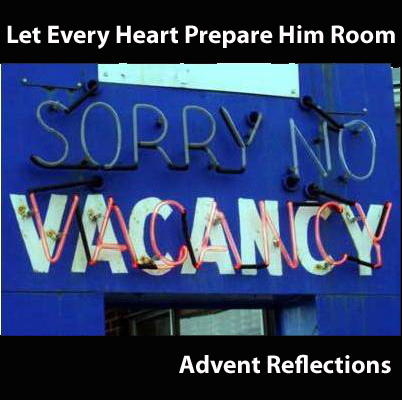 On Christmas, we sing Joy to the World which contains the line: “let every heart prepare Him room.” Quite often, these are simply sentimental words. They are words we like and words we want to be true. However, preparation takes time and we can’t wish our way into preparing room for God in our lives.
In our world of “instant everything”, we can easily transfer the idea of “instant” into our lives with God. We desire to be able to “say the word” and experience relationship with Him. On the one hand, He is always present in our lives but often not in an experiential way. We might “know” that He is near but not experience that nearness in the daily moments of life. The invitation to “prepare Him room” is an invitation to experience Him at the heart level, at the level of our conscious awareness and not simply at the level of theological assent. This doesn’t happen in an instant … it requires preparation in the same way we might prepare to have a house guest.
For many of us, our hearts are like the homes on the television show Hoarders. Every square inch of our hearts are filled with things that we believe will make us happy: relationships, jobs, activities, possessions, even “religious” activities. None of these are “bad” things but they aren’t meant to satisfy our souls. And then, we frequently hold hurts, grudges, habits, or other desires in our hearts. Throw in the busyness of life and there just isn’t any room for a visitor.
On Hoarders, the cleaning project begins with a humble acknowledgement that there is a need for change. Over these next three a half weeks of Advent, we’ll walk through a process for making room in our hearts for Christ.
Our life with God is always an adventure in what Eugene Peterson calls the “middle voice”. In the English language, we understand “active voice” in which we do something and the “passive voice” in which something is done to us. Other languages have the “middle voice” in which one is active and passive at the same time. Peterson writes:
“Prayer and spirituality feature participation, the complex participation of God and the human, his will and our wills. We do not abandon ourselves to drown in the ocean of love, losing identity. We do not pull the strings that activate God’s operations in our lives, subjecting God to our assertive identity. We neither manipulate God (active voice) nor are we manipulated by God (passive voice). We are involved in the action and participate in its results but do not control or define it (middle voice). Prayer takes place in the middle voice.”
The middle voice means that we wait … actively, and that is what advent is all about. There is tension in the waiting but there is no other way. So, the idea is that we allow Him to prepare room in our hearts but we also participate. How will this work? As we allow Him to prepare the room, what is our role? Over these next weeks of the Advent Season, we’ll walk through the following:
Week 1: He humbles our hearts as we wait
Week 2: He softens our hearts as we listen
Week 3: He expands our hearts as we release
Week 4: He occupies our heart as we open
Let’s journey together in these days of Advent as we learn to wait, listen, release, open, and finally celebrate the one who comes to live in our hearts! Advent comes from a Latin word which means “coming” or “arrival” and the days of Advent challenge us to prepare and be in waiting mode. We may have come to know Jesus years ago, but Advent once again allows us to go deeper into the joy of a Savior who dwells with us and in us. He alone is the One for whom we were made. It was Augustine who prayed: “Our heart is restless until it rests in you.” Let’s pray his prayer as we begin living into this Season of Advent …
Great are you, O Lord, and exceedingly worthy of praise; your power is immense, and your wisdom beyond reckoning. And so we, who are a due part of your creation, long to praise you – we also carry our mortality about with us, carry the evidence of our sin and with it the proof that you thwart the proud. You arouse us so that praising you may bring us joy, because you have made us and drawn us to yourself, and our heart is restless until it rests in you. Amen.
Spend some time with that prayer and make it your own.
Tomorrow, we begin with learning to wait … that He might humble our hearts.
A Transforming Thankfulness
The great German writer Goethe once penned: “All that is transitory is but a metaphor.” In that simple phrase, he was saying a lot. That which is eternal is what is most real and that which is transitory is a metaphor which gives us eyes to see the eternal.
All created things are windows into the Divine. This idea is rich and contains echoes of the wisdom of the Hebrew poets:
The heavens declare the glory of God, and the sky above proclaims his handiwork. Day to day pours out speech, and night to night reveals knowledge. (Ps 19:1-2)
O Lord … how majestic is your name in all the earth! (Ps 8:1)
However, quite frequently, we live our lives as though what is seen is the ultimate. When created things are ultimate, we can end up living in a place of discontent and ungratefulness. When created things are ultimate, we believe that we need them to be satisfied. Or, when circumstances are hard, we believe we need to get rid of them in order to be satisfied.
Again, the wisdom of the Hebrew poets speaks boldly:
For a day in your courts is better than a thousand elsewhere. I would rather be a doorkeeper in the house of my God than dwell in the tents of wickedness. (Ps 84:10)
Our satisfaction and joy and purpose in life are found in God alone and the way that we interact with what we see (the transitory) affects whether or not we find our satisfaction in Him. If created things are windows into the Divine, then we can accept all things or their absence as an entry point into experiencing Him. How does this work?
In his writing to Timothy (1 Tim 4:1-5), the Apostle Paul shares that “some will depart from the faith by devoting themselves to deceitful spirits and teachings of demons, through the insincerity of liars whose consciences are seared, who forbid marriage and require abstinence from foods that God created to be received with thanksgiving by those who believe and know the truth.” He goes on to say that “everything created by God is good, and nothing is to be rejected if it is received with thanksgiving, for it is made holy by the word of God and prayer.”
What is the teaching of “demons” referred to by Paul? Quite simply: that some of what God created (e.g., marriage or certain foods) are bad. Paul boldly says that all things are created to be received with a thankful heart. And, through the guidance of the word of God and our relationship with God, all created things are sacred (holy). They propel us to see God and appreciate Him. Marriage! Yes, even a hard one, can be received with thanksgiving and give us eyes to see God. His love, His longsuffering, His sacrificial heart can be experienced in marriage. Having a meal can remind us that God is a provider of all good things. Metaphorically, He gives “daily bread.” The list could go on.
How are you receiving all things with thanksgiving?
Ignatius of Loyola penned some incredibly wise words centuries ago:
“Man is created to praise, reverence, and serve God our Lord, and by this means to save his soul. And the other things on the face of the earth are created for man and that they may help him in prosecuting the end for which he is created. From this it follows that man is to use them as much as they help him on to this end, and ought to rid himself of them so far as they hinder him as to it. For this it is necessary to make ourselves indifferent to all created things in all that is allowed to the choice of our free will and is not prohibited to it; so that, on our part, we want not health rather than sickness, riches rather than poverty, honor rather than dishonor, long rather than short life, and so in all the rest; desiring and choosing only what is most conducive for us to the end for which we are created.”
Is your desire to have the “good things” of life for which you will give thanks or to accept all things as opportunities to know and praise and serve God? The way that you view created things will determine the way you receive them.
Oswald Chambers beautifully states: “We can all see God in exceptional things, but it requires the growth of spiritual discipline to see God in every detail. Never believe that the so-called random events of life are anything less than God’s appointed order. Be ready to discover His divine designs anywhere and everywhere.”
Receiving all things with thanksgiving is truly transforming. Let this be your prayer over these days of Thanksgiving:
Father, give me courage to receive all things with a “yes” … seeing all things as an opportunity to know You and praise You and serve You. On my part, I desire neither health rather than sickness, neither riches rather than poverty, neither honor rather than dishonor, neither long rather than short life, but simply that all things would become holy through You.
If you don’t believe everything in that prayer, pray it until you do!
Cultivating Silence

Silence can be pretty elusive in our modern world and yet it is vital for our souls to survive and thrive in this world. St. John of the Cross (16th century) wrote that “Silence is God’s first language.” Why would silence be God’s native tongue? Because silence is the language of intimacy. Those who are close can sit and just “be” together. Those who are intimate can just “know” what the other person is thinking and feeling without words. God has existed for all eternity in relationship with Himself (Father, Son, and Spirit) and He desires to share that love with His creation. He desires to just “be” with us in silence because it is intimate and communicates a love that is simply present.
Psalm 62:5 is a challenge to our souls: “For God alone, O my soul, wait in silence, for my hope is from him.” Our sense of hope is nurtured in silence. Isaiah 30:15 encourages that: “in quietness and in trust shall be your strength.” Our strength is developed as we are quiet. In our world of words and noise, our souls can become depleted by the constant need to perform and respond and react. Silence refreshes us in God’s love, reminding us that He is the ground of our being.
Teresa of Calcutta said the following about cultivating a true sense of silence that goes beyond outer silence to a true inner silence:
To make possible true inner silence, practice:
Silence of the eyes, by seeking always the beauty and goodness of God everywhere, and closing them to the faults of others and to all that is sinful and disturbing to the soul.
Silence of the ears, by listening always to the voice of God and to the cry of the poor and the needy, and closing them to all other voices that come from fallen human nature, such as gossip, tale bearing, and uncharitable words.
Silence of the tongue, by praising God and speaking the life-giving Word of God that is the truth, that enlightens and inspires, brings peace, hope, and joy; and by refraining from self-defense and every word that causes darkness, turmoil, pain, and death.
Silence of the mind, by opening it to the truth and knowledge of God in prayer and contemplation, like Mary who pondered the marvels of the Lord in her heart, and by closing it to all untruths, distractions, destructive thoughts, rash judgments, false suspicions of others, vengeful thoughts, and desires.
Silence of the heart, by loving God with our heart, soul, mind, and strength; loving one another as God loves; and avoiding all selfishness, hatred, envy, jealousy, and greed.
How will you cultivate silence in your life today? Take a moment and be silent before Him … sit and be still in your soul, releasing any thoughts that surface to His care. Ask Him which of these “silences” you might practice today. Sit and listen. Then, trustingly move forward with your day.
Cultivating silence that rests in God’s love doesn’t come easily or quickly. Silence is a discipline that develops and grows over time. Take 10-20 minutes each day to simply be quiet before Him … intending to rest in Him and listen to His quiet impressions upon your heart. Don’t worry about distracting thoughts … simply use each one as an opportunity to trust Him as you let go of worrying or obsessing or controlling that thought/idea.
Good Behavior Isn’t the Point
 “Shape up!” “Get it together!” “Turn your life around!” “Stop!” Whatever the specific statement might be, we frequently hear messages that are directed toward our behavior. And, the result is inevitably the same … we feel either guilt over our inadequacies or we get pumped up into thinking that we can do it (whatever “it” is). Both responses leave us in the kingdom of self rather than the kingdom of God.
One of the fundamental miscalculations one can make it to think that God’s primary concern is for us to behave properly. And/or, we might also believe that the essence of Godly living is to do things for God. However, as Dwight Edwards shares in his book, Revolution Within:
“God’s first calling on our lives is not usefulness. It is intimacy. Like the first disciples, Christ’s premier purpose for our lives is for us to be “with Him”. Secondarily, very secondarily; He then sends us “out to” minister. How easily we lose sight of this!”
Good behavior is not the point. Doing things for God is not the point. We get mixed up on this distinction because of a misunderstanding of the nature of sin. Sin is not doing bad things. Sin is living independently of God. We were created to live in dependent, moment by moment connection with God. Sin entered into the world, not when Eve ate the fruit in the Garden of Eden, but when that dependent, trust in God was broken. This is why “sin” is said to have entered into the world through Adam. (cf. Romans 5:12) Rather than continuing to trust God together, Adam remained silent when Eve took the fruit. His silence was the behavior that resulted from breaking into independence.
Oswald Chambers notes: “Sin is a fundamental relationship— it is not wrong doing, but wrong being— it is deliberate and determined independence from God. The Christian faith bases everything on the extreme, self-confident nature of sin. Other faiths deal with sins— the Bible alone deals with sin. The first thing Jesus Christ confronted in people was the heredity of sin, and it is because we have ignored this in our presentation of the gospel that the message of the gospel has lost its sting and its explosive power.”
Sins (behaviors) are the fruit or result of living independently of God. Righteousness is living in right relationship with God, or dependence upon Him. Righteous actions are the result of living dependently upon God, in moment by moment communion.
What makes something righteous or sinful? The heart from which it is done. I can tell you that I love you and complement you about how wonderful you are, and that may seem like a great thing to do. However, if I am doing that because I am trying to manipulate you to get something I want, it is not righteous but sinful.
So, why do we so often look to good behavior as the measure of our existence? Quite simply, behavior is manageable and definable. If behavior is the point, then we can remain in control of our lives. We still call the shots. If we don’t agree with God, we can ask for forgiveness later. And, even if we can’t really manage behavior, we can make it appear so.
Sin is about relationship. So is righteousness. Relationship with God is not manageable or definable and sometimes it is just plain mysterious. The very fact that we like to be independent is the reason that we are drawn to behavior rather than intimacy with God. We want answers and formulas and predictability. Relationship offers none of those things. And yet, it is relationship for which we were created.
Another reason, we might be more drawn to behavior is because we have a tendency to be impatient. Relationship takes time and develops fruit over time. Relationship demands all of us, not just our behavior. A. W. Tozer suggested that:
“One marked difference between the faith of our fathers as conceived by the fathers and the same faith as understood and lived by their children is that the fathers were concerned with the root of the matter, while their present-day descendants seem concerned only with the fruit … we demand the fruit immediately even though the root may be weak and knobby or missing altogether. Impatient Christians today explain away the simple beliefs of the saints of other days and smile off their serious-minded approach to God and sacred things … we’ll imitate their fruit without accepting their theology or inconveniencing ourselves too greatly by adopting their all-or-nothing attitude toward religion.” (The Root of the Righteous)
True righteousness (dependent relationship with God) grows over time and is often misunderstood. Several years ago I bought a fruit tree at a local nursery that was on sale for $5. It was a pitiful looking tree that was in no shape for bearing fruit, but I planted it and began to nurture it so that it could “take root.” I remember a friend coming over for dinner and sarcastically asking who planted the “Charlie Brown Christmas Tree” in our yard. It took time but just 5 years later, the tree produced so much fruit that we were giving buckets away to friends. If I had merely focused on the behavior of the plant in those first years, I would have been discouraged and might have even gotten rid of it. However, I pruned it (cf. John 15:2), watered it, and joyfully discovered that it bore fruit when the time was right.
Mystical writer Pierre Teilhard de Chardin suggests patience as well … “Above all else, trust the slow work of God. We are quite naturally impatient in everything to reach the end without delay. We should like to skip the intermediate stages. We are impatient of being on the way to something unknown, something new. Only God could say what this new spirit gradually forming in you will be. Give our Lord the benefit that His hand is leading you, and accept the anxiety of feeling yourself in suspense, and incomplete.”
So, remember, God’s job is to change us and transform us and bear fruit in us. Our job is to remain connected to Him in relationship. And what is the essence of relationship but being together? God is with us. He is present. Are you remaining attentive and conscious of His presence in all things?
An Enlarged Heart
 In the physical realm, an enlarged heart is a cause for concern. It can be life threatening. However, spiritually speaking, an enlarged heart is preferred and actually the pathway to life. The longest psalm of the Hebrew psalter is a beautiful acrostic poem about the Word of God. It expresses a love and a reverence for the Word of God because it leads one to know God and walk with Him and in His ways. It is in that context that we find an interesting statement:
I will run in the way of your commandments when you enlarge my heart! Psalm 119:32
The idea is that when our hearts are enlarged, we run after God’s commands. His commands are His ways, an expression of His loving character. And so, by extension, we are running after Him. In running, there is a sense of abandon. When we run after something, it involves using all of our available physical resources. The picture here is of running after God with all that we are … there is nothing withheld.
Running is a picture of freedom … the freedom to love God without any barriers and to love others deeply. Hebrews 12:1-2 paints this picture as well: “let us also lay aside every weight, and sin which clings so closely, and let us run with endurance the race that is set before us, looking to Jesus, the founder and perfecter of our faith, who for the joy that was set before him endured the cross, despising the shame, and is seated at the right hand of the throne of God.”
Are you running? Does your heart feel big? Do you sense that deep capacity to trust God and love the unlovable? Or, does your heart too often feel small?
There are several things assumed in these words from Psalm 119. First, we can actually be small hearted. In fact, it would be fair to say that without God’s involvement, we will be small hearted. Second, a small heart can hold us back from a life of abandon to God and His ways.
What leads to having a small heart? Think of it this way … we are relational beings and when we experience hurt and disappointments, we have a tendency to protect our hearts. When we get hurt, we frequently make promises that we believe will protect us. For example, we promise that we will never be interpersonally vulnerable because of a betrayal that occurred. So, we erect these “walls” which we believe will protect but they simply isolates us and shrink our hearts. When we protect ourselves from others, we consequently protect ourselves from God as well. As an old friend used to say, “You can’t shut down just a part of your heart.” A wall is a wall.
The writer of Proverbs agrees with this sentiment in Proverbs 18:1, 10-11: Whoever isolates himself seeks his own desire; he breaks out against all sound judgment. The name of the Lord is a strong tower; the righteous man runs into it and is safe. A rich man’s wealth is his strong city and like a high wall in his imagination.
The Psalmist declares that it is God who enlarges the heart, who takes away those protective walls. So, how do we open ourselves to His transforming influence? How do we put ourselves in a place where we open ourselves to the expanding influence of the Spirit of God?
The verses in Psalm 119 which precede verse 32 share several insights about the posture of one who is opening themselves to God. First, the writer says “my soul clings to the dust” and “my soul melts with sorrow.” There is a recognition of his poverty of spirit … from both hurts done to him as well as the fragile nature of his interior life. This is expressed in the phrase: “when I told of my ways. Second, we read the words: “put false ways far from me.” Following the recognition of false ways is the relinquishing of those ways. Finally, we see a restfulness as the psalmist entrusts Himself to God’s word and His ways: “I will meditate,” “I set,” and “I cling.”
Let me suggest three things … they are simple and yet can lead us through the complexities that are often present in our hearts:
- Recognize the walls. They are often most recognizable in the form of anxiety, insecurities, or the desire to control. What are the sorrows of your heart? What are the ways that you build walls? Are there promises that you made from childhood?
- Relinquish the promises that led to the walls. Confess that these walls are not protecting you but isolating you.
- Rest in the truth that He is enough. That He protects and leads and guides. We realize these truths as we meditate on Him and cling to Him. As we recognize and relinquish, there is a space that is opened in our hearts. It can feel lonely or empty but if we feel those things, that space becomes open for His love and grace.
Prayer exercise: prayerfully walk through these three elements. It is slow at first but can become a pattern that leads more quickly to resting in Him.
 desert direction