Category Archives: blog
The Extravagance of Advent … in Letting Go
Part 3 of a weekly Advent blog written by Doug Kelley and Ted Wueste
Advent reminds us that extravagance and abundance come in unexpected packages. Sometimes those packages are bright, shiny, tied with ribbon. We anxiously wait as they sit under the tree or peek out of our stockings waiting for the time to be opened. (True confessions. One of my [Doug] guilty pleasures was watching our young children wait to open their presents while I readied the “adult” part of the morning – fixing freshly ground coffee and warming delectable morsels to snack on during our gift opening ritual.) And, sometimes those packages come in surprising shapes or forms. So surprising that we may struggle at first to see them as gifts. The key lies in waiting for their giftedness to emerge. In fact, some of our most memorable gifts may not have seemed like gifts at all when we received them, but endedendedd
For most of us, we’ve been led to think that “the good life” is about having what we want now (not waiting), conquering (not surrendering), and getting what we can while we can (not letting go). The ancient psalm writer called this way of thinking: “striving” (Ps. 46). When the world doesn’t make sense, often our instincts are to push ahead, to fight, to go for it … to strive.
In that same Psalm, God is presented as the Lord of Hosts. The word “host” might conjure images of hospitality, but the ancient word “host” speaks of angel armies. It is an image intended to conjure hope of God’s power and resources. The idea is that we can stop striving because God is powerful, at work, present with us. That’s the good news. The other news (let’s not call it “bad” news) is that we’re now on God’s timetable, which often means waiting and letting go of our expectations.
We (Doug and Ted) have shared about our common experience with cancer and stem cell transplant over the last few years. When the “c” word gets mentioned, it strikes fear into the strongest of people. The temptation is to fight, to strive, to do anything to remove the difficult situation. However, there is a different path. While it is fashionable to talk about “fighting” cancer and, of course, understandable to want to take things into our own hands and “fix this mess,” what if we are being invited into a space that let’s God do the fighting, the fixing? Of course, none of us wants to receive cancer, but if we wait and watch we may eventually see certain gifts emerge. I (Ted) had a clear sense that the battle was not mine to fight. It was in God’s hands. It was a gift to wait with Him, surrender to His goodness, and let go of trying to make things happen. And, I (Doug) saw this time as one of journey, with God, toward uncertain outcomes, a gift to quiet my heart and journey with God more deeply.
As we discussed in our last post, waiting can be life giving. Letting go is part of what makes waiting life giving. As we wait, we can become aware of fears, impulses, and difficult emotions and, over time, let them go.
The invitation to let go isn’t just about letting go of the hard stuff, it is about being present to what is already there. It represents a significant shift in how we see God and ourselves. Instead of thinking we need more of God or more faith or more hope, we begin to realize that we already have all we need.
Ephesians 1:3 tells us that we have been blessed with every spiritual blessing, and 2 Peter 1:3 reminds us that we have been given everything we need for life and godliness. The challenge is to let go of strategies (like striving and fighting) that may obscure our view of God’s presence and how He is with us, now. As we release those things that we do in the hopes of fixing our lives, we become able to see and fully access the reality of life with God. Remarkably, we find that when we are able to see Him, we become like him (I Jn 3: 2-3).
Meister Eckhardt said that growth occurs “not by addition, but subtraction.” Could this be why the psalmist in Psalm 46 writes, “Be still (cease striving), and know that I am God.” As we let go of our strivings, the subtraction (the letting go) leads us to see what we always sensed was there. God isn’t prodded into action by fervent prayer nor persuaded with right words. He is always with us (Emmanuel). And perhaps as we unwrap the remarkable gift of his presence, tossing off all the ribbons and wrappings and bows that we use to dress up our faith and make it look glittery under the tree, we shall see him “as he is” and be transformed (I Jn 3:2) from death into life.
Brother Sean Glenn (SSJE) notes: “By our holy waiting we will learn to rely on God, who alone has the power to change our minds. For if it is God to whom we surrender the final word about ourselves, we will come to know that this thing that feels like death is actually the way into Life itself.”
Prayer: Lord, give me eyes to see me as you do so that I can see you as you are. And then, give me strength that let go of what obscures my vision so that I can see you clearly. Amen.
Question for reflection: What might you release? Is there something that you might let go so that you are able to see Him as He is?
Reflect on the words of Psalm 46:10, “Cease striving and know that I am God.” Sit with those words and repeat them slowly until they sink down into your heart.
The Extravagance of Advent … in Waiting

Part 2 of a weekly Advent blog written by Doug Kelley and Ted Wueste (The Extravagance of Advent)
Remarkably, both Ted and I underwent treatment for acute myeloid leukemia within the last 19 months. Crazy. Stem cell transplant is a risky procedure in many ways, but actually not as dramatic as it sounds. We were both in each other’s rooms (six months apart) during these critical events, along with other family and friends. Basically, the procedure involved dripping what looks like a strawberry Slushy intravenously into our bodies. It took about an hour. No big deal. Then came the waiting. Weeks of waiting for our new immune systems to kick into gear. Each day, ninety minutes after the 4 am blood draw, we would peek bleary eyed at our Mayo Clinic portals to see if our white blood cell counts had moved from 0. Each day, encouragement from the staff, “It will happen. Be patient. It takes time.” Waiting. Like our lives depended on it…because our lives did depend on it.
What if our lives do, actually, depend on waiting? Pausing? Being present to the moment? Paula Gooder, in a wonderfully insightful advent book, The Meaning is in the Waiting, describes waiting as what gives meaning. We frequently believe that meaning and purpose are found in the future (“Once COVID is over, I’ll be happy, again.” “When my daughter stops rebelling, life will be back to ‘normal’.”). In tangible outcomes. So, waiting becomes more of a “gutting it out,” hoping the future turns out as we want.
Instead, waiting can be a place where we experience God in the present.
The temptation for both of us, post-transplant, was to only wait for the future, “Come on little German stem cells (we both had German stem cell donors). Set up your new home. Do your thing! Then we can get back to normal.” The danger in this, of course, is that waiting for tends to shift our attention away from what God is doing, now. It puts us on a never-ending treadmill of waiting for the next thing, the next event, the next whatever, that we hope will make us feel safe and happy. In sharp contrast, waiting in the present can provide an enduring sense of being with God, listening to Him, receiving His comfort and perspective.
Some have said that God exists in the eternal now. Emily Dickinson wrote, “Forever is composed of Nows.” And, Jesus beautifully points out that, “This is eternal life, that they know [italics ours] you, the only true God…” (John 17:3). Present tense. Not, “will know you,” but do know you! So, when our lives are not just as we hope or when we’re excitedly looking for something to happen in the future, we still find God in the now, not in the next week or the year to come, but now. This is the meaning in the waiting.
Finding meaning in our waiting can also be lost when waiting feels too passive. During our tough seasons, we often find ourselves wanting to “just do something.” Just do anything! Of course, waiting is passive in certain ways. While waiting in the hospital, there was little Doug and I could do to reboot our own immune systems. Yet, there was a beautifully active part of the waiting that was thrust upon us. We were able to intentionally focus on what God has done, is doing, and has promised to do. In this sense, we both had a somewhat counterintuitive experience of deep comfort that resulted from simply being with God. With nothing we could doto “fix” things, we were free to wait on Him … with Him.
When this kind of waiting happens in our lives, we are shaped in the present moment as we connect with God’s heart. In Luke 2:25-35, we read about Simeon who was waiting for the Messiah to come. It had been revealed to him that he would not die until he saw the Savior. This waiting was not a wish or a hope or a dream that he held to the side, but an active waiting in which he watched each day for God’s appearance. This waiting shaped him until he was prepared to see the Savior. The words he offered to the mother of Jesus are poignant:
“Lord, now you are letting your servant depart in peace, according to your word; for my eyes have seen your salvation that you have prepared in the presence of all peoples,a light for revelation to the Gentiles, and for glory to your people Israel.”
Simeon seems to be saying, “I’ve waited, and I’ve seen God’s salvation. If God so ordains, I am happy to die and go to heaven” … with his dreams firmly rooted in what God told him in the past; his daily life shaped by a watchful waiting with God in the present; and his hopes shaped as he waited for the Savior to come. How incredible that his faithful waiting culminated with being on the scene when Jesus was presented at the temple.
How are you waiting in this advent season? Are you waiting with a watchful anticipation, not trying to fix things or make things happen? Are you waiting for the Savior as you wait with Him?
Prayer: Lord, I want to experience meaning in my waiting. Help me to learn to wait on You, in You, and for You.
Question for reflection: Consider that the promise and the hope for the future is God Himself. What might it look like to wait with God and for God? How might that shape you differently than waiting for a particular outcome or event to transpire?
Reflect on the words of Psalm 62:1-2, “For God alone my soul waits in silence; from him comes my salvation. He alone is my rock and my salvation, my fortress; I shall not be greatly shaken.”
In my (Ted) new book, Welcome Everything, I explore more of that journey through cancer – lots of training in waiting. 🙂
The Extravagance of Advent … in Unlikely Places
Part 1 of a weekly Advent blog written by Doug Kelley and Ted Wueste (The Extravagance of Advent)
A few years ago, when Ann and I (Doug) were a tad younger (no kids yet), we were bumped to the penthouse suite when checking into a hotel. Giddy, like kids, we played in our full dining room, enjoyed the sweeping views of the bay and city and, most incredible, called our friends on the telephone next to the toilet (pre-cell phone days!)!
Extravagance. Over the top. Luxury.
Not exactly images that call forth the creche of Advent season. Bereft of adornment, save a single bright star, Jesus enters our world in a stable, surrounded by hay and farm animals – Mary, Joseph, and Jesus all trying to stay warm. Yet, it is in the simplicity of this simple space that God reveals his most extravagant self.
Our eyes are often drawn to the shiny object on the ground but surprisingly, it is in the dirt surrounding this bright bauble that we discover the extravagant … the life of abundance we all hope for. It is frequently in the messiness of life when we are stripped down to nothing that we see. We see that it is not more stuff, more acclaim, more influence, or more power that gives us the life we desire, but it is when we have nothing and are then filled with a sense of completeness and wholeness. When our lives are filled with the shiny objects and/or the pursuit of those shiny objects, there is little room for anything truly meaningful. Maybe it will surprise you note that the US, compared to other wealthy countries, has the highest suicide rate and highest rate of hospitalizations for preventable conditions and avoidable deaths. Our wealth has not always been life giving.
In the incarnation, we see the God of the universe modeling an alternative for us. When God the Son took on human flesh, He didn’t do it as a king riding in on a white horse but as a baby – vulnerable, cold, unable to speak, and completely dependent upon someone He had made. In fact, when He did ride into Jerusalem years later, it was on a donkey – a clear sign that He was not a conquering hero in the classical sense but a humble servant.
We’re told in Philippians 2 that He emptied Himself, and it was out of that “emptiness” that He loved us so extravagantly. In many ways, we have been shaped and formed by Western culture to believe to that life is found in more things, more experiences, more stimulation. The reality is that “more” often confounds our ability to see what is really life giving. We adopt a scarcity mentality and believe we never have enough, rather than an abundance mentality in which we see that we already have everything we could ever need. (cf. Ephesians 1:6) Indeed, “Blessed are the poor in spirit” for the kingdom of heaven is theirs. Or, another way to put it is, Blessed are those living in God’s extravagant Spirit.
Both of us (Ted and Doug), have been traveling a road that includes cancer these past few years and, surprisingly, we have found abundance over and over again – even in the midst of chemotherapy, stem cell transplants, and multiple hospitalizations. Seemingly unlikely places … and yet, the extravagance of God has been abundantly present in our experience.
Is it possible that God’s extravagant love has been waiting for you in some unlikely places, as well?
Prayer: Lord, give us eyes to see the ways that you are present with us in unlikely places.
Question for reflection: Take a look at a few places in your life where you have thought it is unlikely that God will show up. Is it possible His extravagant love is lurking their waiting for you?
Reflect on the words of Psalm 46:1, “God is our refuge and strength, a help in trouble and abundantly present.”
In my (Ted) new book, Welcome Everything, I explore more of that journey through cancer – certainly, a very unlikely place.
Happy New Year

But wait, it’s November 29. Huh? Well, today is the beginning of the year in the Christian liturgical calendar. The “Christian Year” walks through the life of Christ, beginning with His birth. Then, the rest of the year through the of November next year leads us through the story of the Gospel.
Liturgical prayer and worship offer us the opportunity to identify with Christ and His story over and over again. It can become the rhythm of our souls as we not only engage in the story itself but are invited to live it. In Advent, we wait for a coming Savior. In Lent (the 40 days before Easter, we journey with Christ just as He journeyed for 40 days in the wilderness, encountering temptation, loss, and suffering. We celebrate Good Friday, Holy Saturday, and Easter as the culmination of the story. We enter into what is called “Ordinary Time” for much of the year as we learn to number our days and serve with Christ.
In this Advent Season, we wait. We don’t rush ahead to Christmas but engage in a pattern of waiting. We identify with both longing and hope. This orients us to the first coming of Christ and all the reasons why He came. And, we are also oriented to His second coming and the eternal realm.
As we wait for things in life, we can get into a lot of trouble unless we know what we are waiting for. We wait for things like a paycheck or marriage or healing. As we wait with hope, we are able to trust and our love grows deeper.
In Titus 2:11-13, we read: “For the grace of God has appeared that offers salvation to all people. It teaches us to say “No” to ungodliness and worldly passions, and to live self-controlled, upright and godly lives in this present age, while we wait for the blessed hope—the appearing of the glory of our great God and Savior, Jesus Christ.”
Worldly passions are the result of waiting without hope but grace and hope teach us something. They “teach” us or lead us to say “no” to anything but the real thing.
As we enter into Advent this year, here is my prayer …
May we feel the weight as we wait.
May we see the depths and glory of life with Christ. Waiting has a way of shaping us and forming us into a deeper desire and delight in that for which we wait.
Once a week for the next four weeks of Advent, I’ll be posting a blog called “The Extravagance of Advent.” I’ll be co-writing with my friend, Doug Kelley.
And, if you are reading through “Let Every Heart Prepare Him Room” this year. I created a Facebook group for posting questions, reflections, and comments in a community setting. Check it out here: https://www.facebook.com/groups/695166341116258
Welcome Everything
Coming this fall … new book:
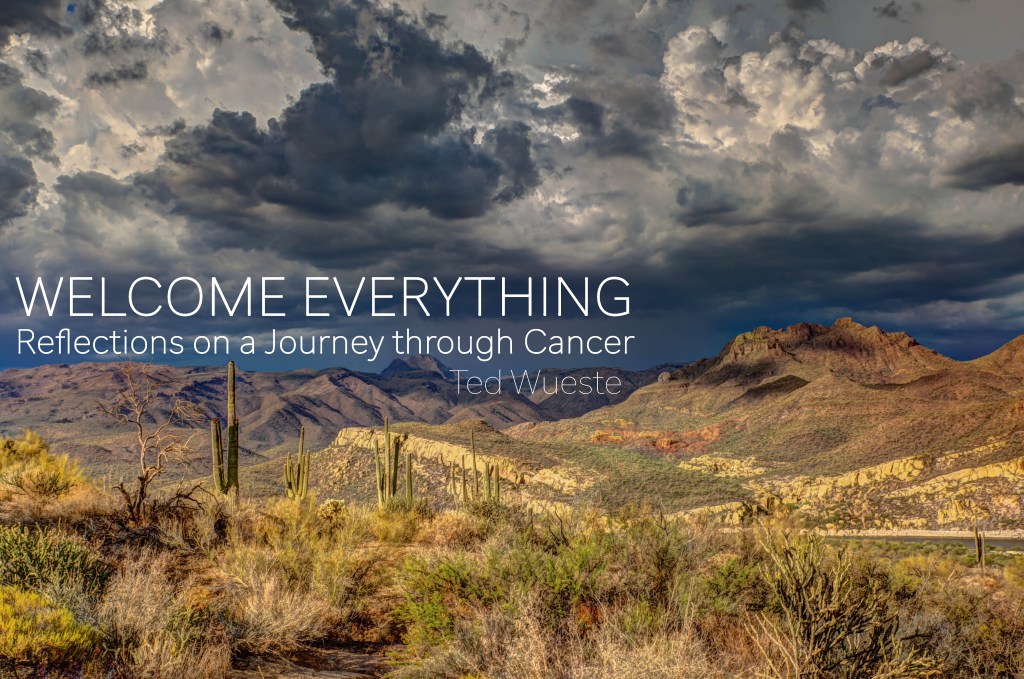
In Welcome Everything, Ted serves as a guide through some of the spiritual contours of a journey through cancer. The story of his battle with both acute myeloid leukemia and Hodgkins Lymphoma is detailed through sharing excerpts from a blog written during two and half years of treatments, surgeries, relapses, a transplant, and a whole host of side effects. Addressing issues that are experienced in a cancer journey as well as any kind of suffering, a hope and an identity securely tied in Christ are themes that run through these pages. Interspersed are chapters of current reflections, looking back at the terrain traversed in these tumultuous years. Not a self-help book or a guide to cancer, this book is a look at what it means to welcome everything, including cancer, as a teacher that can bring more into one’s life that could ever be imagined.
 desert direction